It’s Giveaway Time!


To celebrate the upcoming release of my second novel, All The Colours In Between, I’m having a giveaway competition over on Goodreads. To be in with a chance of winning a signed, first edition, simply click on the link and enter. It’s as easy as that! Open to US, CA, AU and GB. Closes on October 26, 2017. Good luck!

Goodreads Book Giveaway

All The Colours In Between by Eva Jordan

All The Colours In Between

by Eva Jordan

Giveaway ends October 26, 2017.

See the giveaway details
at Goodreads.

Enter Giveaway


The Essence of Dunkirk


Code-named Operation Dynamo, the Dunkirk evacuation (also known as the Miracle of Dunkirk) was the evacuation of Allied soldiers from the beaches and harbour of Dunkirk, in the north of France, between 26 May and 4 June 1940. As a keen enthusiast of history with a Great Uncle who numbered one of the 330,000 safely evacuated from Dunkirk during WWII, I was curious to see film director, Christopher Nolan’s take on the subject. Nolan is famous for films such as The Dark Knight, Inception and Interstellar but Dunkirk is his first historical movie and with an all star cast including, Tom Hardy, Benedict Cumberpatch, Cillian Murphy, Mark Rylance, Kenneth Branagh, not to mention boy band, One Direction’s very own Harry Styles, I was expecting a lot. I’m pleased to say I wasn’t disappointed. And, on the whole, the film appears to have been well received and has clocked up some rave reviews.

However, as with music, art, and books, films are subjective. You can’t please everyone so naturally there have been a few negative reviews and some general criticisms, mostly aimed at some of the film’s general historical inaccuracies. For example, there are Messerschmitt Bf 109 planes featured in dogfights with British Spitfire planes. In the film, the German planes have yellow noses but in reality, the planes were not painted yellow until about a month after Dunkirk. The film also fails to include some of the Indian troops present at the time and there is also, which I must admit I am a bit miffed about, a general exclusion of women, save for the odd stereotypical role where they are providing tea for the homecoming menfolk. In real life, female Auxiliary Territorial Service telephonists (who received two-thirds of a male soldier’s pay) were some of the last military personnel to leave the beach. There also appears to be a distinct lack of the many so-called “little ships”. These were a wide variety of small vessels from all over the south of England including car ferries, pleasure craft, Thames vessels, and speedboats, pressed into service to aid in the Dunkirk evacuation. Nonetheless, I can forgive Nolan and here’s why.

Dunkirk is not a conventional war film; there is very little character development, limited dialogue and no love story. If you’re expecting context and historical accuracy, you will be disappointed. However, if you want a brief glimpse of how it must have ‘felt’ to be present on the beaches of Dunkirk in the north of France between 26 May – 4 June 1940, then this film is a must see. The nemesis of Dunkirk was time and through Nolan’s breath taking cinematography and the brilliant accompanying musical score by composer, Hans Zimmerman, cinemagoers experience the stomach churning anticipation of attack, the waiting, the cold, the fear, the bravery, the hunger, and the loss. Nolan, if you like, captures the essence of the moment of Dunkirk.

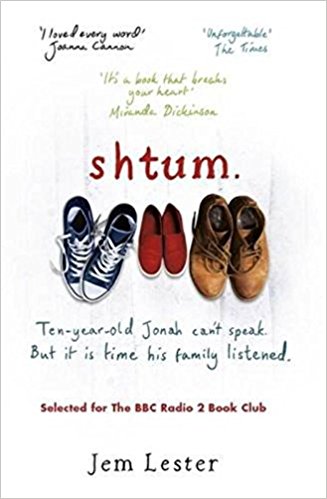
Eva Jordan reviews… Shtum by Jem Lester

Book Review

41PAZK74yJL._SX325_BO1,204,203,200_

Publisher – Orion

Shtum is definitely a book I will not be keeping shtum about. At times heartbreakingly sad, at others wonderfully witty, although the humour would be best described as dark, this is a candid tale about three generations of the Jewell family and what it really means to live with, and care for, an extremely autistic child.

Married couple, Ben and Emma, agree to do whatever it takes to give their autistic son, Jonah, the opportunity of a better life. Jonah is offered a place at a specialist residential school but Ben and Emma have a fight on their hands with the local authority. To strengthen their case, Ben and Emma pretend to split up, after all, it’s difficult enough to care for a severely autistic child without the added problem of single parenting. Ben and Jonah move out and take up residence with Georg, Ben’s father and Jonah’s grandfather.

The three main protagonists throughout are Jonah, Ben and Georg, and all three are brilliantly drawn and flawed. Ben is immature and never really wants to take responsibility for anything, using alcohol to anesthetise himself. Georg, who clearly adores Jonah, is, at times, overly harsh and judgemental of Ben. However, it is ten-year-old Jonah, who sometimes kicks and bites that I really fell in love with. Unable to talk, Jonah is central to the storyline and, as the blurb says, “lives in a world of his own. He likes colours and feathers and the feel of fresh air on his skin. He dislikes sudden loud noises and any change to his daily routine.”

Be warned though, this is not a sugar coated tale of triumph over adversity, or of amazing parents coping with superhuman qualities. This is a story of heartbreak, pity, and self-blame. However, it is also a story about love, of family and secrets, and a story about fathers and sons, and forgiveness. It is tragically real but also warm, insightful and full of compassion. And, as the story unfolds, what becomes painfully obvious and wonderfully ironic is that, although he has no voice, Jonah speaks much louder and more eloquently than either his father or his grandfather.

Clearly based on the author’s own experience, Shtum is a remarkable story that shines a “no holes barred” light on the everyday reality and struggles some families of autistic children experience. Gritty, funny and poignant, it is a marvellous portrayal of ordinary people managing extraordinary difficulties during day-to-day life, and, one that will stay with me for a very long time.


Eva Jordan reviews… Beautiful by Katie Piper


Book Review41kYkuYpxiL

Publisher – Ebury Press

Several months ago, I had the great honour and pleasure of meeting the writer and TV presenter, Katie Piper. The victim of a horrific acid attack, mostly to her face, neck and upper body, Katie is a shining example of triumph over adversity. Friendly and approachable, Katie, who smiled constantly, proved to be genuinely warm and extremely generous with her time. So, this month’s book review is a work of non-fiction by Katie Piper.

Katie’s autobiography, Beautiful, explains how she was attacked, her life beforehand and the events leading up to that terrible, fateful day. Age twenty-four, living in London, Katie was a beautiful, successful, and ambitious young woman when she was brutally raped by her then-boyfriend, whom she had met on Facebook weeks earlier. Several weeks later she then had acid thrown in her face, also initiated by the same said boyfriend. “I heard a horrible screaming sound, like an animal being slaughtered … then I realised it was me.” However, if Katie’s perpetrator thought she was going to crawl away and hide her injuries from the rest of the world, he was sorely mistaken. He clearly hadn’t bargained for such a courageous and gutsy young woman. Through the love and support of wonderful family and good friends, not to mention an iron will powered by true determination and courage, Katie completely turned her life around. To many, she is both an inspiration and a role model. She is also, I think it is safe to say, still beautiful, incredibly successful and rightly ambitious – despite one man’s attempts to sabotage such qualities.

Some of you may recognise Katie from TV shows like Bodyshockers and Face to Face and like me, you may have read about her terrible ordeal back in 2008, but also like me, you may not have realised the full extent of her injuries, and the pain and suffering she endured, both mentally and physically. “It was just a normal mirror, a round sheet of glass encased in a white plastic frame, but as I reached for it, my hand trembled. ‘Take your time, Katie,’ my psychologist Lisa said gently…But I didn’t do things by halves – I never had…All of a sudden, that normal little mirror became a window into hell.” Katie has had and continues to have, countless operations and skin grafts, she is blind in one eye and because she swallowed some of the acid that permanently scarred her face, neck and arm, she also suffered internal damage, resulting in a great deal of scar tissue around her oesophagus. This left Katie unable to eat and swallow food properly, which again resulted in yet more surgery. Katie makes no attempt to hide the fact she struggled after her attack, describing some very ‘dark’ times, however, this is also a story of hope and inspiration.

Well composed, Beautiful is easy to read but not an easy read. Nonetheless, it is also written with great warmth, humour and aplomb. One woman’s triumph over evil and living proof that life does go on despite, at times, unimaginable difficulties and suffering.

Katie Piper


Write Your First Novel – In A Month!


machine-writing-1035292_960_720

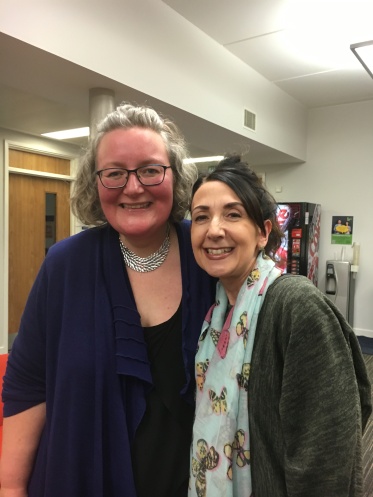
A couple of months ago I had the pleasure of attending an author event to hear crime writer, Elizabeth Haynes, talk about her writing career. I also had the honour of meeting and chatting with Elizabeth afterwards, who proved to be both lovely and very gracious with her time. After then going home and devouring her current novel, Never Alone (a great read and one I’d highly recommend if you like crime thrillers) which I read and reviewed last month (and you can read again here), I decided to write a post about the event, and pass on some of Elizabeth’s writerly wisdom

Elizabeth, a former police intelligence analyst, hasn’t always been an author but, like me, she did always aspire to be such, one-day. Her first novel, Into The Darkest Corner was published in 2011 and won Amazon’s Book of the Year and Amazon’s Rising Star Award. During the course of the evening the author discussed her previous career and where she gets her ideas and inspiration from to write her novels. The idea of Never Alone came to Elizabeth when she was thinking of moving house and found herself spending far too much time browsing through the houses of various property websites. She came across a grey stone house nestling in a remote country hillside providing the inspiration for the house in the novel, Four Winds Farm, which plays a pivotal role in the setting of Never Alone.

The author also discussed, despite juggling a family and a full time job, how she eventually came to write her first novel. She became, and continues to be, a participant in the National Novel Writing Month, otherwise referred to as NaNoWriMo – an annual challenge to write 50,000 words in the month of November (approximately 1667 words a day, or roughly four sides of typed A4 paper). So, this is my challenge to all you would be writers out there, you have a couple months to prepare yourself before the start of November and possibly the start of your first novel. It may mean getting up a couple of hours earlier every day, or going to bed a couple of hours later each night. It may also mean you let the housework slide for a couple of weeks, get someone else to do the cooking, walk the dog, whatever – but it is only for one month.

However, Elizabeth did also point out that 50,000 words is not a novel (most novels are anything from 60,000 to 100,000 words, much more in some cases), but what you will have is the bare bones of a novel, a good start and something you can build on. Why not take a look at the official NaNoWriMo website nanowrimo.org and sign up now. You’ll find lots of help and inspiration, including pep talks and the chance to meet other authors online and in person. Good luck if you take part and please let me know how you get on!

Elizabeth Haynes

Me and Elizabeth Haynes!

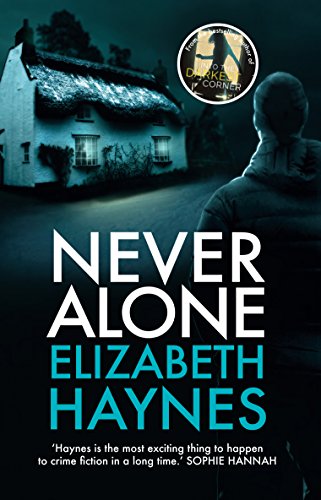
Eva Jordan reviews… Never Alone by Elizabeth Haynes

Book Review510uL5rtumL

Publisher – Myriad Editions

My Review

This is the first novel I have read by crime writer Elizabeth Haynes and I can safely say it won’t be the last. Gripping, thrilling and wonderfully written, for me, it was a real page-turner.

Never Alone is a story about Sarah Carpenter, a middle-aged widow who lives with her two dogs in a remote farmhouse set in the North Yorkshire Moors. Sarah has two adult children, Kitty, her daughter, who is away at university most of the time and her son, Louis, who, although lives locally to Sarah is, for all intents and purpose, estranged from his mother. Still struggling to come to terms with the death of his father, Jim, it’s obvious Louis blames his mother for his father’s death despite the fact it was clearly an accident.

Sarah too is struggling, but her battle is more about isolation, what it means to live alone. ‘She has a house and debts, and, while she doesn’t need to worry about the children any longer, it’s a hard habit to break, worrying.’ Neither particularly happy nor unhappy she is presented as someone who, although on the surface appears to be reasonably calm and collected, is nonetheless floundering. When she first met her husband, Jim, as a young woman at university, although she didn’t love him, at first, ‘he promised to be there for her forever, and it was that permanence that attracted her. The idea that whatever lay ahead, she would have Jim.’ However, when Aiden, an old friend from university, also the ex-best friend of her deceased husband, turns up and agrees to rent the small cottage Sarah has at the back of her farmhouse, Sarah quickly realises she is not alone. And, as the story unfolds, she also realises there are worst things than being alone.

Narrated through two voices, namely Sarah and Aiden, as well as one unknown malevolent voice, it soon becomes apparent Aiden is hiding something from Sarah. The story starts off quite slow then gradually picks up pace culminating in a number of shocking twists and turns.

Easy to read, Never Alone, is a well-written psychological thriller that is as much about human relationships as it is about the human psyche. The characters are well rounded and believable and Haynes cleverly uses the weather (being snowed in), location (the isolation of the moors and the old farmhouse, Four Winds Farm) and animal instinct (the whines, low growls and body language of Sarah’s two dogs, Basil and Tess) to build atmosphere and tension that greatly add to the mounting suspense of this brilliant read. Definitely one I’d recommend.

Writing – The School of Hard Knocks.


“Hardships often prepare ordinary people for an extraordinary destiny.”

                                                                                   – C S Lewis

absorbed-2409314__340

“Writing – ain’t for the faint hearted.” Who said that? Oh yes, of course, me! And if you think it is, I suggest you give up now. It often involves long, solitary hours tapping away at a keyboard, in front of a computer screen, where emotions are apt to swing violently from belief your work is the next big thing to the worse piece of writing on the planet – ever. Then there are the edits and the rewrites and that’s long before you start submitting your work. And once you do, there’s every possibility it will be rejected. But if you are lucky enough to get a publisher, or indeed as many brilliant writers now do, successfully self-publish, you’re still putting your work ‘out there’ for public scrutiny. Reviews are vital to a writer and sometimes they’ll be great, at others, brutal. So without doubt, the one thing you open yourself up to, as a writer, is rejection and criticism. In fact, that’s probably a given for most things in life, especially those that catapult you, one way or another, into the public arena, which of course writing most definitely does.

However, how can you become known as a writer unless you take a chance? Luckily, reading is subjective. There will always be those (hopefully!) who love your work and sadly those who don’t. Never let rejection or bad reviews sway you from pursuing your writing dream though. Rejection is a strong test of character. Nonetheless, I do accept there will be days when it’s not always possible to remain so philosophical. So, for all the writers and would be writers reading this and suffering a crisis of confidence, here is a list of famous writers whose novels were initially rejected.

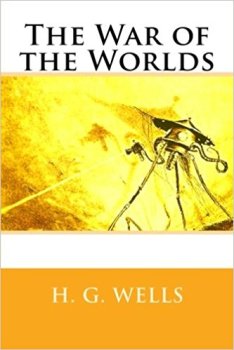
  • A publisher rejects H.G. Wells The War Of The Worlds, describing it as “an endless nightmare.” Eventually published in 1898, it has been in print ever since.

41t5FlQEplL._SX331_BO1,204,203,200_

  • Louisa May Alcott is told to “stick to teaching.” She doesn’t give up on her dream to become a published writer and later Little Women goes on to sell millions. Some 140 years later it is still in print.

31Ior5+qNCL._SX304_BO1,204,203,200_

  • Agatha Christie experiences 5 years of continual rejection before landing a publishing deal. Her book sales are now in excess of £2 billion.

41WctdQZYhL._SX259_BO1,204,203,200_

  • In 1968 Ursula K. Le Guin receives a letter from an editor suggesting her book, The Left Hand of Darkness is “Hopelessly bogged down and unreadable.” It goes on to become one of her many best-sellers, regularly voted as the second best fantasy novel of all time, next to The Lord of the Rings.
  • Stephen King was told, “We are not interested in science fiction which deals with negative utopias. They do not sell.” Carrie sold over one million copies in the first year alone.
  • Initially rejected by 16 literary agencies and 12 publishers, the modest print run of 5000 copies for John Grisham’s, A Time To Kill,  quickly sells out and goes on to become a best seller. He now has combined sales of 250 million.

513Dzz-wfWL._SX322_BO1,204,203,200_

  • The Christopher Little Literary Agency takes on a new client. Her novel is rejected by 12 publishers. Eventually picked up by an editor at Bloomsbury, the company agree to publish but tell the writer to get a day job as she has little chance of making money from children’s books. Yet Harry Potter and the Philosopher’s Stone by J.K. Rowling generates a series of such books, setting records as the fastest-selling books in history, with combined sales of £450 million.
  • Small publishers in San Francisco, Macadam/Cage, fall in love with and agree to publish a debut novel sent to them. Prior to this, 25 literary agents rejected it. Translated into 33 languages and adapted as a movie, Audrey Niffenegger’s, The Time Traveller’s Wife sells 7 million copies.
  • Only selling 800 copies on its limited first release, the author finds a new publisher and Paulo Coelho’s, The Alchemist, sells 75 million.


Eva Jordan reviews… Love and a Dozen Roast Potatoes by Simon Wan

Book Review51ZuEu4AZ4L

Publisher – Urbane Publications

You know the hero always gets the girl right? Well, what if the hero gets the girl but she’s not the right girl? Worse, what if the girl doesn’t actually want the hero?

Such is the life of our romantic hero as he negotiates the triple threat of trying to becoming a cheese ball superstar, finding his cartoon princess, and bringing her home for a perfect Christmas roast potato. It’s a life tale of comic disasters, sex (lots of weird sex), relationship nightmares and discovering your nakedness in a world full of people wearing the same old clothes.

Honest, warm, funny and very hip, this is David Nicholls with the tears, the pain and the naughty bits put brazenly on display for the world to see.

My Review

If you like the idea of reading something a little different then this is just the book. Honest and warm with lots of laugh out loud moments plus a couple of weird ones to boot (check out the acknowledgements to give you a bit of an idea), this is the story of one man’s quest to find true love.

As Shakespeare himself famously wrote, “the course of true love never did run smooth” and never has there been a more appropriate turn of phrase when it comes to the complicated love life of Mr Simon Wan. Beginning at the tender age of eight, the author takes us right back to the 1980s and the first girl he fell in love with, Claire. Having only been at his new school for a couple of days, Claire and her friend feel sorry for the half-Chinese boy being teased by the other boys. In a bid to make him feel better, the girls kiss him on the cheek. “The next playtime, the boys who called me ‘chinkychong pong face’ were a little more interested in being my friend…and that probably set the precedent [for my life] for the next thirty-two years.”

With an obvious zest for life and an honest love and appreciation of women (all kinds of women), as well as music and fashion, not forgetting the roast potatoes of course, the writer then proceeds to walk us through three colourful decades of his life and the never-ending story (and yes, that sentence is alluding to a friend of said author who gets a mention in this book – think eighties pop icon with spiky blonde hair) of his search for true love. And it’s all there, the long hot summers, public transport, the video player, mixtapes, skateboards, drink-fuelled fights and drug-fuelled raves – “we drove around the country lanes in the middle of the night searching for phone boxes that would lead us to hidden rave arenas and when we got there we danced until it was a different day. Life was fast. Life was about lasers and ecstasy, nothing could stop us. We had the keys to a brave new world. We were invincible.”

Snappy, fast-paced but easy to read, Wan is masterful at painting pictures with words. He is also brutally honest about himself and although, on the whole, the book remains upbeat and wonderfully witty throughout, Wan doesn’t sugar coat his faults or his mistakes, which in a way only makes him more endearing. He is human and doesn’t try and hide it. Written with great humour and sincerity, if you’re looking for something a little different then I’d definitely recommend Love and a Dozen Roast Potatoes. But be warned – be prepared to feel very worn out after reading it. 

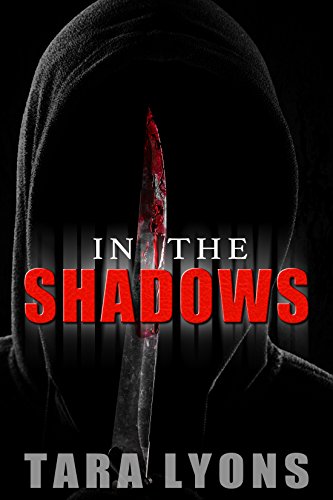
Eva Jordan reviews… In The Shadows by Tara Lyons

41KOkRVBJRL

Publisher – Tara Lyons

Detective Inspector Denis Hamilton is tasked with apprehending a brutal murderer stalking the streets of London – and leaving not a shred of DNA evidence. As the suspect list mounts, his frustration and pressure from his superiors intensify.

Grace Murphy, who is dealing with the recent loss of her beloved grandfather, falls deeper into despair when her friends’ bodies are discovered. Fearing she may be the killer’s next target, she begins to question if her horrifying nightmares are the key to unravelling the murderer’s identity.

How far would you go to uncover the truth? Would you venture into the shadows to unmask a killer?

My Review 

In The Shadows is the debut novel by crime writer Tara Lyons and what a gripping read and great start to her writing career it is. Set in present-day London, a serial killer is on the loose and young women are being murdered. The opening sentences of the prologue introduce the murderer and leave little room to doubt the state of their troubled, deeply disturbed mind:

They never found the first dead body. I didn’t want them to. I was in control, powerful, and important. My fingers tightly gripped the smooth black knife handle, and I felt the rush of excitement as the sharp tip pierced her chest. All my energy, power and hate spurred me on, telling me to push harder – so hard that I saw the last breath escape her dark lips and mingle with the frosty midnight air…It was the first time I took someone’s life and the rush was euphoric.

The story unfolds through the voices of three main protagonists, namely the assistant director of a local theatre, Grace Murphy, Detective Inspector Denis Hamilton and, faceless and nameless, the murderer themselves. However, Grace was the character I felt most drawn to throughout the book.

Deeply sensitive, Grace is clearly struggling after the recent death of her beloved grandfather. It also becomes apparent she was either a friend or colleague of some of the murder victims, which of course gives Grace grave concern for her own safety. Does she know the killer and if so is she the next victim? Her sleep becomes plagued by nightmares and more often than not Grace reaches for alcohol, seeking solace at the bottom of a wine bottle, or two. Of course, as should be the case with any good whodunit story, Lyons does a great job of offering the reader a selection of possible suspects including her slightly creepy, slightly inappropriate boss Michael, and Grace’s love interest Eric, who thinks nothing of using women, Grace included, for his own gratification.

At the insistence of her stricken mother, Grace seeks psychological help to try and make sense of her troubled dreams. She agrees to undergo hypnotherapy in the hope of providing some understanding, some link to the murders still taking place around her. With no real evidence or DNA will be Grace be the one to help DI Hamilton and his team?

I became quite invested in the characters of the story, particularly Grace, and my only small criticism is that there was not enough background information on them. Grace was clearly close to her grandfather and there was no doubt she was affected by his death so it would have been both helpful and interesting to have a bit more information as to why the recollection of important or special memories. However, I don’t think we’ve seen the last of Grace Murphy so perhaps the writer will tell us a bit more about her in her future novels. Nonetheless, fast-paced with plenty of intrigue and suspense, In The Shadows is a great psychological thriller and a great read.

Boadicea – The Warrior Queen

moon-625450_960_720

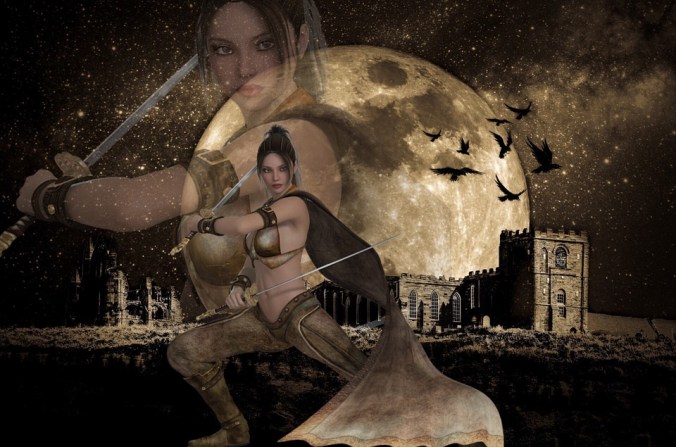
Illustration courtesy of Pixabay

The Warrior Queen

During recent research for my second novel, due for release in autumn this year, I found myself gathering some interesting facts about Boadicea, or as she is recently referred to, Boudicca. On-going debate as to the correct pronunciation of her name still continues, my children having been taught at school that the latter was correct, and I the former. I personally prefer Boadicea so from hereon in will refer to her as such. And no, just for the record, in case anyone is wondering, I haven’t switched genre to write about historical fiction for my second novel. Like my debut, my second novel is also a work of contemporary fiction, I just happened to come across Boadicea in my search for inspirational women of history. Boadicea demonstrated strength of character and endurance at a time of great adversity, both for herself and her daughters, as well as the people of her kingdom. History teaches us that all did not end well for Boadicea but she did not take her humiliation lying down. And, more importantly, she reminds us that once upon a time, before the Roman invasion of Britain, women were part of a social structure that encouraged equal rights.

Not much is known of Boadicea’s early life and her birth date is not recorded but general consensus suggests she was born into a royal house as a member of the Iceni tribe, based in the area now known as Norfolk. Manda Scott’s modern novel’s based on Boadicea’s life suggest it likely she was brought up in a largely peaceful environment where both sexes would have taken similar rolls in the running of the lives of the Iceni tribe, including mastering the skills necessary to defend themselves. This way of life was then threatened after the Roman invasion of Britain around 43CE. Boadicea and her husband Prasutagus, King of the Iceni, found ownership of their land and wealth threatened. A deal was struck and Prastuagus was allowed to remain in control of his land and money, but only with the status of ‘Client King.’ However, Prasutagus drew up a will leaving half of everything to his wife Boadicea, and their daughters, and the other half to the Roman Emperor. This did not sit well with the Romans because women in Roman society had no rights of ownership or inheritance. After the death of Prastuagus in 60CE the Romans refused to honour his will and Boadicea’s attempts to claim her rights were viciously denied. She was whipped, her estates confiscated, and her two daughters raped. The Romans may have left us with a rich legacy of innovation and invention including straight roads, sewers and sanitation, hot baths and bound books, but they also destroyed a social structure that had been so important to the women of the tribes of Britain, namely equality.

During Victorian times a memorial of Boadicea was commissioned and still stands today. Somewhat overshadowed by the London Eye on the opposite bank of the Thames, she can be found on the north-east corner of Westminster Bridge. Next time you are visiting London why not take a look at the statue of the ‘Warrior Queen.’ Driving her carriage, arms aloft, defiantly holding a spear with her daughters standing behind her, she looks very formidable. She also serves as a reminder that there was a time in bygone history when men and women in Britain had equal rights to property, power and inheritance. This does leave me wondering what recent historical relations between British men and women would have been like had we inherited the sexual politics of the Celtic tribes rather than those preferred by the Romans.