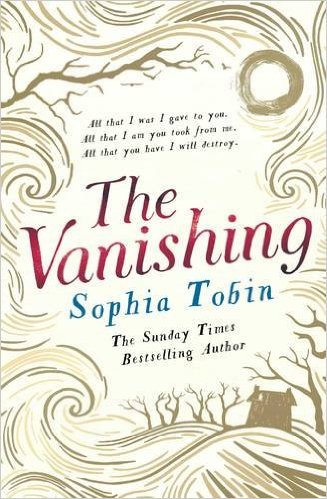
Eva Jordan reviews… The Vanishing by Sophia Tobin

51CL1Gao1pL._SX325_BO1,204,203,200_

Published by Simon & Schuster

When runaway Annaleigh first meets the Twentymans, their offer of employment and lodgings seems a blessing. Only later does she discover the truth. But by then she is already in the middle of a web of darkness and intrigue, where murder seems the only possible means of escape…

My Review

I love historical fiction, Dickens, Conrad, Austen, Eliot, Gaskell and Shelley, not forgetting the brilliant Brontë sisters and yet, I have to admit, it’s been a while since I last read a book in this particular genre. However, after reading Sophie Tobin’s The vanishing, I had to ask myself why?

Beautifully written, this dark tale of intrigue and deception is set against the backdrop of England’s nineteenth-century eerie Yorkshire Moors. Add a brooding Byronic villain who (in the words of Lady Caroline Lamb when referring to Lord Byron) could be best described as “mad, bad and dangerous to know,” a persecuted heroine and a remote setting alluding to aristocratic decay and madness, this atmospheric tale of mystery also bears all the hallmarks of good gothic fiction.

Annaleigh Calvert leaves behind the hustle and bustle of her London life, including her beloved adoptive father, and heads for Yorkshire to take up the position of housekeeper at White Windows, a somewhat decaying mansion nestled among the remote Yorkshire Moors. Annaleigh is also fleeing heartache; only White Windows is not the sanctuary she hoped for. “I felt disappointed,” she said. “I had come here to escape from sadness, and yet the house in that moment seemed the opposite of a place where one could be happy. It seemed to crouch in the rugged landscape, as though cowering from the rain.”

Her employers, the Twentyman’s, are a somewhat aloof brother and sister, Marcus and Hester. They appear pleasant enough however all is not as it seems. Hester, slightly melancholic and “colourless, like a watercolour executed with too much water” relies on opiates to help her constant headaches. Her brother Marcus, at times arrogant and at others troubled, is a contradictory character yet Annaleigh finds herself strangely drawn to her broody proprietor. “He looked at me, and the keenness of his gaze, needle-sharp and perceptive, startled me anew.”

Nonetheless, Annaleigh struggles with the isolation of her new home. And why is she warned by the other two resident servants not to get too close to her employers? And, more importantly, where did the previous housekeeper Kate; disappear to – apparently without a trace?

Although well paced, I did find The Vanishing somewhat slow, to begin with. However, it quickly picked up pace keeping me gripped to the very end. Tobin’s characters are well drawn and her descriptive use of language while both beautiful and haunting is also, at times, amazingly brutal. Through Annaleigh, Tobin explores the historical entrapment of women within domestic space as well as their subjection to patriarchal authority.

However, although subservient, as Annaleigh’s position would have dictated at the time, Annaleigh does discover a strong will and strength of character within herself that is refreshingly at odds with her place in society. The Vanishing is a story of love, betrayal and revenge and the perfect read for a cold day in front of a warm fire.


International Women’s Day 2017 – #BeBoldForChange

man-2013447_960_720

Today, Wednesday 8th March is International Women’s Day 2017. With its humble beginnings going as far back as 1911, International Women’s Day is regarded by most as a way to celebrate the economic, social and political achievements of women. And, although the world has made great strides toward gender equality, especially during the last several decades, major disparities between men and women still exist. Women from all walks of life still face disadvantages. Around the world women will earn on average only 60 to 75 per cent of men’s wages and are 65 per cent more likely to work in informal, and often unpaid, work. And for some this still appears to be perfectly acceptable, the idea of gender parity preposterous, proven several days ago during a discussion with members of the European Parliament. Politicians were debating the pay gap when Polish nationalist MEP Janusz Korwin-Mikke shared his thoughts on the subject. He stated that,

“Of course, women must earn less than men, because they are weaker, they are smaller, they are less intelligent. They must earn less, that’s all.”

This is shocking to say the least and until this conscious and unconscious bias is challenged and completely eradicated, women still have some way to go before they can truly observe a gender balanced society.

However, although there is still some way to go, women in more developed countries, in general, have come a long way. Sadly this is not the case for those living in countries still developing. Activists for women in developing countries tend to focus on more basic issues like combating violence against women and providing equal access to vaccines, basic healthcare, and primary education.businesswoman-453487_960_720

Therefore, as both a woman and mother of daughters, I feel compelled to acknowledge such an important day. I hope this post will help draw attention to some of the ongoing issues still experienced by women and eventually lead to a change in attitudes that find us living in a more gender-inclusive world. Unfortunately, the World Economic Forum predicts that the gender gap won’t close entirely until 2186 and I for one don’t believe this is acceptable. I implore anyone who wishes to help bring about change to mark this day. It doesn’t necessarily have to be anything big or grand, we all live busy lives but even the smallest gesture or acknowledgement can make a difference. You may even be rather surprised as to who takes note – like I was last year.

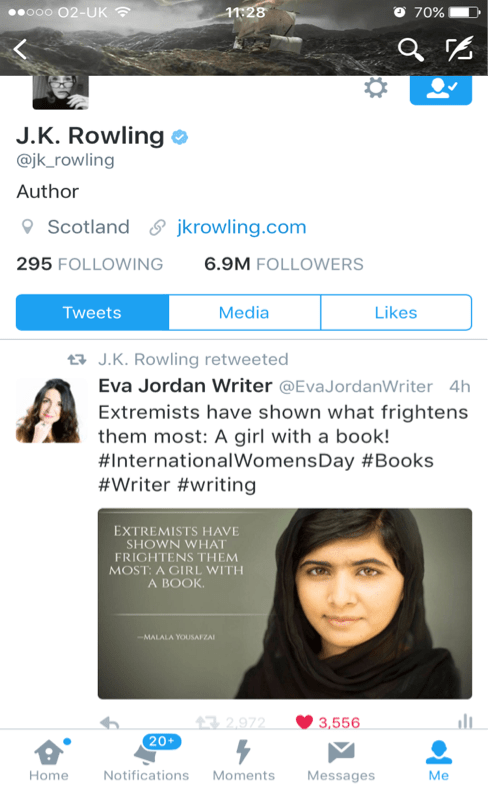
To mark IWD in 2016 I posted a tweet on my Twitter account of a quote by Malala Yousafzai:

“Extremists have shown what frightens them most: A girl with a book.”

Malala was shot in the neck and head by the Taliban in October 2012 in the Swat Valley of Pakistan. She was attacked because she advocated a girl’s right to an education; an idea that the Taliban fervently opposed. Malala was only 14-years-old at the time and amazingly, Malala survived. The extraordinary thing about my story though is how quickly my tweet was retweeted. I’d like to say it was all down to me for posting such a poignant message but the brilliant truth is it was mostly due to J.K. Rowling – and yes I do mean the writer! J.K Rowling retweeted my tweet and thanks to her that particular tweet now has 8,363 likes and has had 6,159 retweets, which only goes to show that sometimes even the smallest contribution or support towards change can have a far greater reach than you’d ever imagined.  

J K Rowling

If you do tweet some words of inspiration today, don’t forget to use the hashtag campaign theme #BeBoldForChange and if you’d like some more information about IWD you can take a look at their website here.

If you’d like to take a look at the video footage of Janusz Korwin-Mikke you can visit the BBC News (World) Twitter account here where you can also see the brilliant response to his statement by the Spanish Socialist member Iratxe Garcia Perez – go girl!

team-spirit-437512_960_720