Eva Jordan in conversation with… M.A. Comley

I am chuffed to bits to have the wonderful Mel Comley as guest author on my blog today. Author of the Justice Series and the Intention series, Mel is one of the few indie authors listed as a New York Times and USA Today bestselling author. Here, Mel gives us a fascinating insight into how she started her writing career.

*****

Thank you for inviting me, Eva, it’s been a long time since someone has asked me to write a blog post for them. 🙂

Now, what to choose as a subject, I know, how about writing!

To me, writing and entertaining my fans and the general reading public is like a drug. I’m addicted to writing. I have over thirty titles to my name now, most of which are fast-paced thrillers, the rest are either romances or some erotic titles that I write under a pen name.

My love of writing started when I moved to France back in 2002. I began reading a Mills and Boon romance, the only book available in English at a French library at the time, about halfway through the book I threw it down in disgust and turned to my Mother and said, “I could do better than this!” That day, I enrolled in a home study Creative Writing Course and wrote two romances, but I felt something was missing, it was a chore to write them to be honest. A friend of mine lent me a James Patterson novel and the speed of that book blew me away. It was then that I began writing Cruel Justice, that first book took me over 18 months to complete, however it was the second book in the Justice series, Impeding Justice, that I unleashed to the world first.

Back in 2010 the ebook market was still in its infancy, so I picked up some valuable fans right from the word go. Impeding Justice made it into the top 40 in the Amazon UK chart and in the top 100 in the USA. It was such a thrill to see the book doing so well that I quickly wrote Final Justice, when I say quickly, it still took over 6 months to write. When I released Final Justice my fans started writing to me asking to see more of Lorne and Pete’s relationship. I revisited Cruel Justice, tweaked it a little and then released that book. It was simply amazing to see Cruel Justice romp up the charts on both sides of the Atlantic and accomplish a top 20 place in the UK and settle in the top 30  in the USA, but what pleased me even more than the high rankings on my babies, was the wonderful emails I received from my fans, it simply flabbergasted me.

Now, I just can’t stop writing. In the past few months I’ve released The Caller, written by my co-author, Tara Lyons and myself, plus I have two more titles on pre-order, although Mortal Justice will have been released by the time this post appears. The other title, Devious Intention is due for release in Aug 2016, this is a psychological thriller, the third book in the Intention series about a PI duo, Ellie and Brian.

The past six years have been incredible for me, I’m one of the few Indie authors out there who is  listed as a New York Times and USA Today bestselling author but having those accolades under my belt hasn’t altered me at all. I still work over 100 hours a week, why? Because I love writing and entertaining people.

To anyone thinking that this writing lark is a way to make a quick buck – it ain’t. Only people who are committed to their craft and determined to succeed will make it in this world. It takes stamina and a lot of willpower to keep coming up with great plot ideas and believable and likeable characters who the reading public fall in love with.

Thank you again, Eva, I hope I haven’t bored people too much. 🙂

MelMel Comley

M.A. Comley on Social Media:
Website
Newsletter Sign Up
Facebook Page
Twitter 

Eva Jordan in conversation with… Anna Shenton

I am really pleased to have the lovely Anna Shenton as guest author on my blog today. Author of Seduced By Mind Tricks, Lust For Survival and Writing Spelled Out, Anna also runs the really friendly and helpful Facebook group The Writers Authors and Readers Group. As well as telling us a little about herself, Anna also explains how daydreaming helps her to write.

How daydreaming sessions helped me write! 

Thank you Eva, for the kind invitation to write a guest post. Having read many of your wonderful posts I realise I have my work cut out, and hope to make this fulfilling, interesting and joyful.

Anna Shenton (1954) – I was born in a small village in Staffordshire, England and experienced an interesting upbringing by my English father, and German mother. My two elder siblings Ilona and Steven, and later, a surprise brother from Germany helped fuel my imagination for writing. We lived in the real world in our new council house, metal window frames, freshly plastered walls, newspaper squares on a string in the bathroom, home-made ginger beer in the pantry, strawberries in the garden and lots of helpful neighbours!!! Woow!!!

My flair to create comes from my family, I think. I have a locally famous artist, Uncle Stan Richards, who has and continues to, paint and sell many beautiful paintings, often donating proceeds to the air-ambulance. My late father enjoyed pencil/cartoonist drawing which he occasionally contributed to the Daily Mirror. I spent many hours watching him sketch with charcoal; hence, I also like to dabble for fun myself.

My Late brother wrote his Debut Novel (Notes in the Margin) in Mumbai, which unfortunately hasn’t been published. I hope to look into this soon. And last but not least my Sister writes a very popular frugal blog (Mean Queen) she is amazing.

Always known as a bit of a daydreamer in class I was determined to put my vivid imagination onto paper someday.

Having left school at the ripe old age of fifteen I started work in a new Sainsbury’s store where I trained and became Senior Chief Clerk.

Ok, you want to know a little more about me today!!!

I live in Staffordshire with my lovely retired policeman hubby. We love to travel with our touring caravan – Any country goes!! Our favourite pastimes is walking, cycling, eating and enjoying a bottle of wine or two.

Ah yes… we do go to the gym and swim daily too, whilst not gallivanting!

We share a fantastic family of six sons and daughter-in-law’s, and millions of adorable grandchildren, so to say the least, there is no shortage of inspiration.

We fill the garden with vegetables to share with them and the toy cupboard overflows onto the bunk beds which they occasionally, in turn, sleep in, with the famous big ted!

Christmas is always a family affair!!

Always loved to write. Kids flown the nest! I ploughed into a home study course with the Writing School of London. Amazing stuff!  Success with Star Letter Pages and Fillers for Women’s’ Commercial Magazines was encouraging.

Venturing forward, my articles were soon published in Hobby publications, Practical Caravan, Caravan Magazine, Modellers World and Writers Forum International.

Poems didn’t go amiss either. Growin’ Owd – my pet poem – won World Book Day prize 2015 with Vind & Vag Publishing House, and, I loved writing short stories for writing group anthologies, where I used to be fund organiser.

Inspiration from life experiences and reading other authors helped me write Seduced by Mind Tricks, my debut romance novel and create short stories.

Want to share my love for writing, with – I wanna be a writers’ friend. My eBook Writing Spelled Out is devised and rewritten from my articles to help all budding authors.

Take a peek at an excerpt – How Daydreaming Sessions enriched my writing.

Whatever you’re doing take your characters, ideas, events with you. Adapting a habit of holding daydreaming sessions with yourself will compose a sketchy plan and actuate results.

The mind is a very powerful thing, daydreaming uses a complete range of images, feelings and sounds from your memory. It can conjure up an alternative life and outcome for your characters for instance.

Memory is not abstract, it’s built from bits and bobs and provides the writer with material, and all we have to do is probe every mortal strand possible. But with that, comes a word of warning, don’t allow yourself to slip into living in solitude as a hermit.

It is imperative to keep juices flowing and add to your personal memory bank getting as much on board as possible. So get out there and get involved in as many events, functions, and social affairs as possible with your eyes and ears wide open. You are probably thinking well how am I going to find the time to do all that in my already busy life? Don’t worry; your daily routine will also throw up a few ideas for good measure. Even half an hour sitting in the park or café can illuminate the exact situations or answers you’ve been looking for. Listen and watch! Then note! It works for me.

Everyone’s creativity is sparked by unique circumstances, so start searching deeply and laboriously into your subconscious with the following examples in mind which will throw out varying shades of sunlight. The power of daydreaming can transform rags to riches. So if you are sitting comfortably, close your eyes: slow your mind down and get ready to lift-off into the unknown.

Using characters for instance – to get the imagination revolving begin with a simple exercise by inventing lives for strangers you’ve seen in the park or café. You haven’t got a clue what this person does, no plots, goals or aims. So who is she? Where is she going? Why is she walking alone? Does she resemble someone you know? Give her a name to shape her image. This will add to or may conflict with your mental picture later.

Bait planted firmly, you can now expand on it. Exercise the imagination, turn your first impressions, thoughts around into different lights, hear what it’s saying, and play with it. Note down anything interesting, images perceived. The woman I saw in the park looked pale and fragile, her skin like tissue paper, her grey-hair greasy and thin – like rats tails. She will make a perfect third character in my short story, Family Inheritance, once I have taken her up to my domain, and dissected, with what if…? Or suppose that…?

A prime example of an exercise is to re-enact in mind an incident that has happened, imagine what the outcome would have been if things had gone differently.

The following example is taken from a short story in progress. The plot is a little sketchy at this point; I need to dress it up, add fire and colour, present my characters vividly and move the story forward. So I’ll take Jenna and her mum with me while I sprawl out on the sofa and gaze expressionless at the lounge ceiling.

Jenna and her divorced mum get on well, the dilemma being that Jenna wants to move in with her fourth boyfriend. Mum hit’s the roof, it won’t work.

What situation can I conjure up to make Jenna see she’s making another mistake?

Muddling it around in my head finding several conclusions I try to envisage every possible route by applying suppose that… or what if..?

I decide to let Jenna go, but in the meantime because of the upset she has caused, mum rents out Jenna’s room to a dear old friend.

On the other hand, mum could have sold up and moved north – or disagreed with Jenna entirely, disowning her – or insisted on moving in with the happy couple to make sure he doesn’t do the dirty.

My daydreaming session helped me visualise the most appropriate situation to move the story forward and entice the reader. Jenna and her mum in your head, what does your daydream reveal? Take your time, various scenes will appear and you may find that some elements you originally thought just don’t fit. You can then ask yourself; why did her mum do that? Or why is Jenna doing this? You will begin to think further ahead and the story will form into a plot as you guide it. Although, this doesn’t mean we should ignore the initial plot, as it is essential to have an early framework.

To refresh your daydreaming delve into your private fantasies, and keep your mind active. Read widely, observe details and study people. Daydreaming also creates ambitions and goals, setting you on the path to achieving these things. It really does wonders for the imagination.

Thanks for taking the time to read this fellow writers, authors, readers and friends. I hope you found it fun!!!

Currently, I am working on a Historical Novella early 1900’s I don’t intend to rush this as I want to enjoy the experience and create the book as I wish.

Also, The Writers Authors and Readers Group is my passion. A layman in Facebook skills landed me with the group accidentally, but hey it has turned out to be awesome. We have some fab people on there and I am happy to help others. You are welcome to join, send a request it really is inspiring!

Anna Shenton

Anna Shenton:
Facebook Page
Facebook Group
Amazon Author Page


Eva Jordan in conversation with… Amanda Saint – Author of As If I Were A River

As If I Were A River

I’m very pleased to introduce fellow Urbane published author Amanda Saint on my blog today. Only released in April this year,  As If I Were A River is Amanda’s debut novel and has already received some rave reviews. It was selected as a Netgalley Top 10 Book of the Month for May 2016 and included in the WHSmith Travel Fresh Talent promotion.

Alison Moore, Man-Booker shortlisted author of The Lighthouse, says of As If I Were A River: Amanda Saint’s intricately plotted debut novel is a juicy Pandora’s box of mysteries and revelations.” 

As well as being a novelist, Amanda is also a short story writer and features journalist. She also runs her own creative business, Retreat West, providing all sorts of writing events. A nomad at heart, her feet haven’t stopped itching yet so she keeps on moving. 

Today, looking at the idea of missing people, Amanda discusses some of her research behind her debut novel.

Missing People

The premise of my debut novel is built around people that have gone missing but also about missing people, both in the physical sense as they are not there anymore but also in the emotional sense of wondering what might have been if they were still around.

One of the narrators is Kate, the youngest generation of three women in a family who tell the story. The story starts when her husband, Jimmy, vanishes and she has no idea what has happened to him or where he might be. But this serves as a catalyst for her to confront the issues she has been holding onto since childhood when her mother left the family and was never seen or heard from again. How this has affected everything she’s done since and how her personality has developed.

In researching the novel, I read many stories and watched documentaries about people who had gone missing, spoke to volunteers at the Missing People charity, and questioned the police in the local missing persons unit where I was living at the time. This helped me to create a realistic scenario around how Jimmy’s disappearance would be dealt with on an official level.

For the emotional reaction, I spent a lot of time just sitting and thinking about how I would feel if it happened to me and suddenly my life was no longer going to be what I thought it was. But in order to really create a compelling story I needed more conflict for Kate, there needed to be something else from her past that would add more pressure and that’s when I realised her mother, Laura, had disappeared from her life too. Once this piece of the puzzle fell into place the story really took off.

But I realised that part of the reason I was so interested in missing people is that my life has this theme running through it too. I didn’t meet my biological father until I was in my thirties; at the time when I started writing this story my husband hadn’t seen his sister for about 15 years and, due to a family falling out I wasn’t a part of, I hadn’t seen any of my cousins, aunts and uncles for about 20 years. So I had done a lot of that wondering about what relationships might have been if people had stayed around.

All of this fed into each of the three women’s narratives who tell the story and although it is a very sad tale, there is also a strong vein of hope, optimism and redemption running through it. Now that I’ve had time to step back from the story and be a bit more objective about it – I think what it essentially boils down to is that all you really need is love.

Purchase As If I  Were A River here.

Amanda Saint

Amanda Saint on Social Media:
Facebook
Twitter


Eva Jordan in conversation with… Steven Hayward

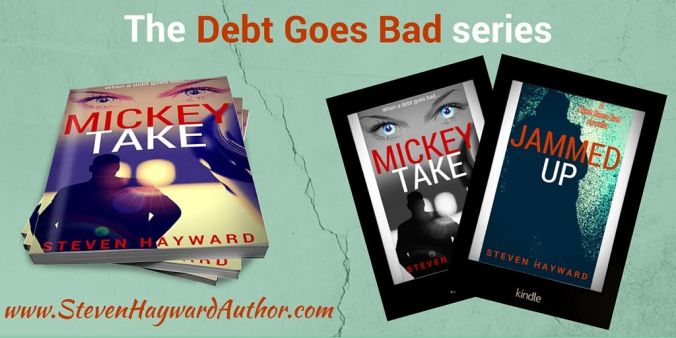
It is my very great pleasure to introduce the wonderful Steven Hayward as guest author on my blog today. Steven is the author of the crime thriller Mickey Take:

In this complex criminal web, Mickey doesn’t know who to protect and who to fear. But with even those closest to him seemingly involved, who can he trust? A hapless pawn in a bigger game that’s playing out between local crime lords, all he knows is whatever happens, he’s not going back into that bloody chamber…

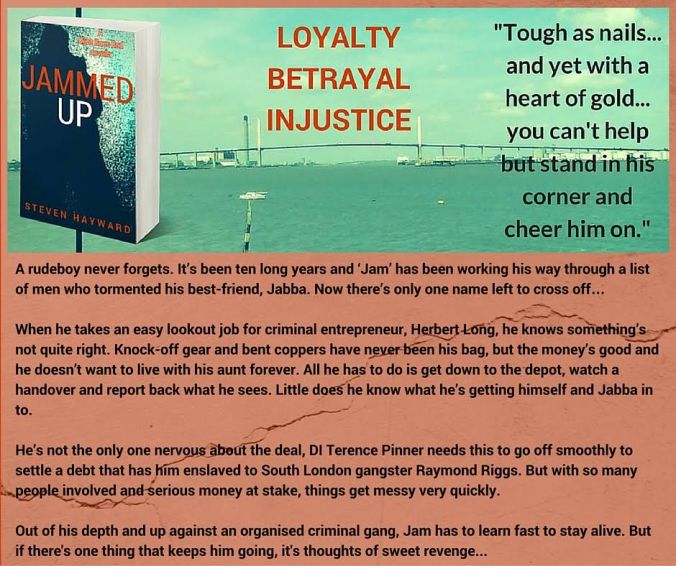
Mickey Take is Steven’s debut novel. His latest book Jammed Up: a Debt Goes Bad is a novella that is both a prequel and an introduction to Mickey Take and if you sign up to Steven’s newsletter (see below) you can actually obtain the ebook version for free! Now, read on for a fascinating insight into the research behind Steven’s writing.

Anatomy of a Rudeboy

A few years ago, not long after leaving the security of a structured job and a regular income in banking, I almost fell into the trap faced by many debut novelists when I started writing Mickey Take: When a debt goes bad… In the opening scenes of the first draft, Michael Field introduces himself as an ex-banker looking for a new direction. Several re-writes later he was to become the impetuous but slightly vulnerable Mickey, who, having kicked out his wife for cheating on him, stormed out of his job the very next day under dubious circumstances only to be lured back into the murky world of revenge and murder he’d barely escaped in his youth. So, thankfully, no other similarities there, then!

Having decided last year to develop the original novel into the Debt Goes Bad series, I wanted my latest book, Jammed Up: a Debt Goes Bad novella to act as both a prequel and an introduction to Mickey Take. Having set it a few years before, but against the same backdrop of feuding gangsters and police corruption, I needed a new central character who, much like Mickey, was likeable with a good heart, but was easily led and, through the circumstances of a misdirected youth, almost fatally flawed.

unnamed

I only had to look a few miles west of where I live, to Croydon in South London, to discover a sub-culture emerging at the turn of the millennium that was (and likely still is) an underclass of youth, largely ignored by the media and, at best, misunderstood by most. Under-privileged teenagers, often from broken families and frequently of mixed race, perhaps in search of an identity, are drawn together by a common interest in a specific genre of music, and a love of American branded sportswear.

Enter the Croydon Rudeboy, with a cocky swagger, his back-to-front baseball cap doffed in homage to the gangster rap scene of the USA — but without the guns and the bling! Instead, a Rudeboy has to improvise to impress, wearing his flamboyant trainers (“creps”), with only the rungs of the laces visible beneath the oversized tongues thrust forwards like peacocks’ tails by the balled-up socks wedged behind them. And a Rudeboy is never without his hoodie in a brand to match his trainers: it has to be Nike.

He grew up in a deprived South London suburb — the self-styled “Jam” hails from the Thornton Heath (“Fornton Heaf”) area of Croydon. And he attended, sporadically, failing schools — Jam went to Ingram High, which years before had been a respected grammar school, but was later shut down for being one of the worst-performing state schools of the mid-1990s. For a Rudeboy, school was an unwelcome intrusion into the fun and meaning of daily life. It was “long” (boring) and “dry” (irrelevant) and engendered high levels of illiteracy and disaffection. However, don’t underestimate his intelligence. With a high IQ in street smarts, he is nobody’s fool. Likely to be the son of a white mother and an absent black father, he’s an outsider who, rather than rebel as a means of trying to fit in, effectively conspires to create an exclusive sub-culture with the primary purpose of keeping everyone else out.

The music scene is all about UK Garage (“garrij”), centring on MC rappers, like duo DJ Luck and MC Neat; DJ EZ (“easy”), N’n’G, The Artful Dodger and Craig David. On the radio, the Rudeboy listens to Kiss FM where DJs Tuff Enough Brown and Jam Lamont (aka. Tuff Jam) send out “big-ups” to the listeners’ crews: “Dis is goin’ out to ma man Jam in da Fornton Heaf Massif!” Between 1997 and 2001, the South London pirate underground radio station, Upfront FM pumps out UK garage, and when on the move, beneath his hoodie, the Rudeboy always has on his Walkman earphones.

“Grounded in the youth subculture of Lonjam, theirs was an intimidating mongrel of South London and Jamaican parentage; a patois rich with biting satire and linguistic inventiveness that continuously evolved.”

In addition to the music and the clothes, the Rudeboy is perhaps best characterised by his London Jamaican dialect. In the company of elders and non-hostile strangers, he tends to be polite and reticent, and unlikely to use excessive “LonJam”. When Jam first appears in the opening scene in Chapter 1 of Jammed Up, he’s with his new boss, a white man he would respectfully refer to as “cuz”. In contrast, he calls a fellow-Rudeboy “bruv”, or simply “rudeboy”. But even then, the older man is easily confused by some of his words and phrases as Jam describes a father-less upbringing of intimidation and violence, and the need to grow up fast and to quickly learn to defend himself. Later, when he speaks to his friend, a man-child he calls “Jabba”, the dialogue between them is unconstrained.

“Several years of living north of the river had dulled their edge and back home, they would now have been considered outsiders. But whenever the young men came together, they reverted to the Croydon Rudeboy personas of their teenage years.

‘It was mental, bruv,’ Jam said. ‘I’m meant to keep it on da d-low. Dat place is proper bait.’

‘Wh’appen, bruv?’ Although a couple of years older, Jabba spoke with the eager curiosity of a child, symptomatic of the mild cerebral palsy he’d suffered at birth. Their friendship was such that Jam no longer noticed.

‘Oh my days, blood,’ Jam said, ‘It’s a big-arse grimy house, all mash up wiv two room from breeze block.’”

Another characteristic is the casual use of drugs, particularly the smoking of marijuana. “Bunnin'” would be a regular activity. And so would “graffin” – as teenagers, Jam and Jabba would have been the scourge of the south London railway network as they left their tags emblazoned in graffiti across trains in the overnight sidings at Norwood Junction. Elsewhere, nightlife would include The Blue Orchid opposite The Fairfield Halls in central Croydon or, before the Tramlink was built in 2000, teenagers too young to make it past the bouncers there, along with the ones barred entry for wearing their creps, would frequent “the dive” that was Club Vision in Church Street.

One quality a Rudeboy nurtures on the street is the loyalty he retains towards one of his own. Unlike Mickey, when Jam is offered a questionable job by small-time gangster, Herbert Long, he jumps in with both feet. But for him, the challenge becomes almost too great when he can’t help involving his vulnerable friend…

“‘Okay… so I go dere, watch wh’appen, den what?’

‘Just do the job and I’ll be back in touch. And don’t bother saving any of the phone numbers – you won’t be able to ring or text me back. So, are you in or not?’

‘Yeah man.’

‘Good lad. One last thing.’

‘What?’

‘If you tell a living soul about this… or if you do anything stupid tomorrow, like being seen or worse still, getting caught… I’m not going to be able to guarantee your safety, understand?’

‘For real,’ Jam said slowly, his heart beginning to race. He’d chat it over with the punch bag first and look out for the text later. He pressed the red button on his Nokia 8210 and dropped it in his bag. Grabbing his Walkman on the way out of the room, he slipped quietly down the stairs and out the front door. He pulled up the hood on his new Nike top, and with N’n’G playing in his ears, jumped back on the tube to Bethnal Green, where he walked the rest of the way to the Boys’ Club on Cheshire Street.

On the phone, later that evening:

‘Jabba… ’s’Jam. Come to ma yard, now yeah.’”

unnamed

My greatest fear as an author writing Jammed Up, was that the extensive use of dialect in the main character’s speech may alienate some readers. My hope is that there is enough context in which to follow the gist of Jam’s dialogue even when his words may not be familiar. I’m glad to say, since Jammed Up was published on 26th May, readers seem to be taking to him and enjoying his cheeky patois. But for those who may be struggling, here is a Rudeboy’s thesaurus* of common words and phrases:

Vocabulary of a Rudeboy

bait committing a misdemeanour, or danger/threat
balls it to hide drugs down boxer shorts
bang/merk have sex
bang up/bus’ up beat up or beaten up
bare lots of/excessive, or really
belly up laugh uncontrollably
big up embellish or applaud
skin up/billin’ up roll/-ing a joint
blatantly obviously/definitely
blood/bredder/bredrin/bruv friend/fellow rudeboy
blow job shiner
bruck up break or broken
bunnin’/bun smoking/weed, hash, grass, skunk
buff/fine/fit/tic pretty
butters ugly
buzzed/buzzin’/lean stoned
chirps/chirpsin’ chat/-ing up
creps trainers
crusty/dry/dusty/long boring, irrelevant, of no meaning or appeal
cuz a white friend or older person
dappy daft/silly
deep (“dat’s deep, man”) bad/serious
feds police
fraff nonsense talk
for real yes exactly/that’s true
frontin’ challenging/confronting
graffin’ spraying graffiti
heavy/hectic good
hood up feeling uncomfortable on the street
jack/jacked rob/robbed
keep it on da d-low keep a secret
lau dat/lau it leave it/let it go/don’t make a fuss
liber’ies taking liberties
likkle little/small
mash up destroy/destroyed
massif crew/gang
merk/shank stab
oh my days!/gosh!/life! oh my God!
on ma jays alone/on my own
our ends our area/patch/manor
proper really/exceptionally
pull a whitey get sick from too much weed
rudeboy friend
screwin’ angry
spark/tump hit/punch
tag/taggin’ graffiti signature/spraying to mark territory
touch a stroke of luck
trus’ believe me/trust me
uh-uh you know! the cheek of it!
vexed stressed
(ma) yard (my) house/place
yes-yes pleasant greeting
yoot unknown/rival young male
yer get me precisely/exactly/I agree
you know dat tell me about it/I hear you
zoot spliff/joint


* With my acknowledgement and thanks to Annabel, Roxanne and Jacqueline Andrews for providing many of the linguistic and cultural references that brought Jam and Jabba to life.

If you’d like to read more, Jammed Up: a Debt Goes Bad novella is available as an e-book from Amazon, Kobo and Nook, with a paperback edition due out later in the year.

Subscribers to the Followers of Fiction newsletter can obtain the ebook for free here.

Steven Hayward on social media:
Website
Facebook 
Twitter


unnamed