Eva Jordan in conversation with… Ross Greenwood

Eva Jordan in conversation with Ross Greenwood - Lazy Blood - Post Header

I’m extremely pleased to introduce fellow local author to me, Ross Greenwood. Ross is the author of the debut novel Lazy Blood. Now published by Bloodhound Books with a brilliant new cover, I thought this would be a great opportunity to remind everyone why they should read his book.

Are your friends to die for?

Did you make friends at school?
Are they still your friends now?
Do you trust them?
Will is on his way to prison. His life is a mess, but who is to blame?

Here, Ross talks about what inspired him to write and he also gives us a brief idea of what to expect from his second upcoming novel The Boy Inside.

‘Lazy Blood.’

By Ross Greenwood

I never wanted to go to prison. It was certainly not one of my choices at school when asked. Doctor, postman maybe, radiographer (obviously later on), never prison. I had passed my A-levels but was so unfocussed I just decided to get a job. As the years went by I seem to find myself working in a variety of call centres. First, as a phone jockey and then as a manager. Good money, as I was good at it, but hardly inspiring stuff. I found myself never staying in one job for long. Even now, at 42, the last job at 4 years’ service is over twice as long as anything I had achieved before.

I found myself travelling to get my thrills. The usual holidays when I was young, 18-30 etc., European capitals, then later 3 months in Asia and a year in Australia. More obscure capitals followed, living in Spain and then a month in Indonesia and 3 months in South America, before unexpectedly (how did that happen) children arrived. It was at that point, as I was trying buy-to-let and being a landlord, that the need to write a book was becoming very difficult to put aside. I had met such a range of people and had participated in so many amusing, mad events that I hoped I had a book people would be interested in.

I began what eventually became Lazy Blood. Life gets in the way and soon the need to get a job outweighed the urge to finish the book. I was stuck anyway. I had managed to mould many different attributes of hundreds of different people into four likeable and flawed characters, but I was struggling for a start and a beginning; the bite that would make the book interesting and exciting.

I wanted a career change though. No more insurance companies and depressing Mondays, I wanted something exciting. I was going to get it. I actually wanted to join the Police but, as you can imagine, my CV wasn’t going to stand any kind of investigation. The prison service wasn’t so fussy. As government cuts bite it is even less so now, the staff are leaving in droves.

After the training, how I got through those first few weeks I will never know. Only a commitment to myself to finish what I started got me through that period. HMP Peterborough is a B-category local jail. The hardest type to work in. We were constantly understaffed, sometimes running 80 man wings on your own for hours at a time. It is a revolving door for some, the drug addicts and shoplifters, but it takes all the prisoners from Cambridge, Huntingdon and Peterborough Crown and Magistrates Courts.

So there were murderers, rapists and psychopaths merged in with dangerous drivers, embezzlers and drug dealers. All of them meshed together in a crazy world of violence, depression, suicide, anxiety, drug abuse, self-harm and disorganisation that they weren’t allowed to escape from.

Obviously after a little while I had more ideas and stories than I could ever imagine. I was desperate to get back to writing my book. All the time the book was percolating and composting in my head. I think that was one of my coping mechanisms. When they wanted volunteers to put riot gear on and break up a barricade, I would be there, sometimes just for the experience. When you work in that environment, you certainly know you are alive. Then another child came along and the book went back on the shelf.

By that time I had got to grips with the job. I found consistency, professionalism and politeness with a certain amount of apathy was generally the best way to get the job done. Aggression and arguing generally led to assaults and rage. The prisoners get to know you too. They know which officers will help them and they are also fully aware what a tough job it is.

Another year went by and I took child friendly hours and started to work in Resettlement. The idea behind it was that you assisted them when they arrived in prison. For example, ringing the bank for them, finishing tenancies and then when it was time to leave you set about making sure people had somewhere to go. Unfortunately that wasn’t always achievable.

This job still had its difficulties as some people were almost impossible to help. There are many charities out there and Peterborough Council do a brilliant job in housing people, but If you have been made to sign the sex offenders register or, worse, are an arsonist, then it is very hard to find somewhere for you to live as there is a duty of care to existing residents.

I got to chat to a lot of people and got much more material! I still wanted to finish my book and my boy gave me the opportunity. He was waking for his four a.m. feed and with a sense of determination that this was my time, I completed it in the early morning hours. Lazy Blood is available on amazon and has been well received. Just £1.99 until the 1st May.

Prison is a crazy place, not for the faint hearted. It is an unnatural environment but not what people expect. Prison for most is Bad Girls, Shawshank, Prison Break and Porridge. A British jail is none of these things. Most people there are not ‘bad’ people. Sure there are career criminals and obviously these figure strongly in the book too. That’s why we love crime books, but many have just done something stupid. Perhaps used their phone whilst driving and killed someone. Silly things with terrible consequences. Got involved with drugs and had to steal to service their habit. Maybe borrowed a few quid from work and things have got out of hand, or had a few beers and got in a fight. These things could happen to most of us. This is their story too. The list is endless and so are the ideas for characters.

I finally left the job after nearly four years to get my first book published and take a year out to do some more writing. I will look back fondly on my time there though. By far and away it was the worst job I ever had, but it was also the best job. I worked with some amazing people as well. The money wasn’t great, but the commitment had to be. I’m nearly six foot tall, mature (ish) and fourteen stone so I walked on those wings armed with physical presence and life experience. You had to bow your head to small school leavers on their first day in the job, whose nervous hands fumbled with confusing keys, as they entered the abyss.

What I wanted to focus on for my second book, ‘The Boy Inside,’ was one of the more depressing and sad parts of prison society. The young. Before you judge these boys in hoodies you should really have walked a mile in their shoes. I know that is a little cliché but many of them never stood a chance. Parents who were drug dealers for example, or no parents at all.

Once you are in the police and prison system, especially as a juvenile, it is hard to get out. The people in it often do not have the skills, knowledge or finances to climb out of the hole they are in. They become careless, chaotic and have no expectation of any kind of future. They are a burden to society and there seems to be little appetite to deal with these issues. There are many who work tirelessly with young people and try to get them back on track, often without being paid, but it is hard work and often unsuccessful.

Ironically to paraphrase The Shawshank Redemption, a life without hope is a terrible thing. Many of these issues are brought up in ‘Lazy Blood’ and the ‘The Boy Inside,’ but they are also books about persistence, determination and luck. In some ways, they are also modern love stories. I hope to change your perception of those who end up in prison, but after reading these novels there is one thing I can be sure of. You will never want to go there yourself.

Lazy Blood is out at Amazon now, read the reviews and you decide!

Ross Greenwood on Social Media:
Facebook
Twitter 

ross

Eva Jordan in conversation with… Alex Gordon

I’m really pleased to have the lovely Alex Gordon as guest author on my blog today. Former Sports Editor of the Scottish Sunday Mail, Alex is the author of no less than twelve works of non-fiction about football. However, several years ago Alex had an idea for a whodunnit story and, choosing to ignore the advice of some publishers who cautioned against writing fiction, Alex had his first novel, Who Shot Wild Bill, published in 2013. 

The first of a quirky mystery series to include a former sports-journalist turned-detective (wonder where he got that idea!), Charlie Brock, as the main protagonist, Who Shot Wild Bill was then followed by the second book in the series, What Spooked Crazy Horse and Alex is currently working on the third in the series.

Here, Alex talks us through his journey from fact to fiction, and what a fascinating journey it is!

**********

So, I’m propping up the bar at The Kelburne on Millport’s Stuart Street, sampling a small libation and chatting to my good friend and owner Eddie Hughes and a few of the regulars. As the former Sports Editor of the Scottish Sunday Mail – in the good old days when the newspaper was read by three million folk back in the early-to-mid-nineties – the topic, not entirely unexpectedly, is about football and how the clientele in this wonderful little howf would make Scotland a world power again.

As the author of several football books – twelve at the last count – there is a question that has cropped up a few times. Now if I had a quid for every time I had been asked why I had never got around to writing a novel, I would be penning this while sipping a refreshing ice-cold pina colada beside the shimmering pool of an ocean-going liner floating nonchalantly and serenely somewhere in the Med off the coast of the South of France.

Okay, maybe a little far-fetched. How about sitting shivering in a leaking rowing boat somewhere in the angry, choppy Firth of Clyde with a few over-zealous seagulls using me as target practice?

Right, fair enough, that might be stretching the imagination too far, as well. Would you settle for me standing in a puddle in Glasgow’s Sauchiehall Street during one of the country’s innumerable and, apparently, mandatory traditional summer thunderstorms?

To tell the truth, there had been a germ of an idea swirling around my cranium for a whodunnit for several years. I had been brought up on a staple diet of Agatha Christie (mixed in with a mountain of football autobiographies and biographies) and I just can’t get enough of extremely clever mystery writers.

On one of the days in the Kelburne, as we once again put the world to rights, someone just happened to mention there had never been a recorded murder on Millport. That was the kick-start I required, a challenge that had been presented at that precise moment.

The Country and Western Festival was a couple of months away and, almost immediately, a conception of a storyline crystalised in my imagination. What if someone staged a murder during the wild west weekend? There were wannabe Buffalo Bills, Wyatt Earps and Billy The Kids all over the place and many, of course, were equipped with fake firearms strapped to their hips. I had seen these guys strolling around the Millport promenade making the place look like Dodge City. In fact, I hadn’t realised there were so many cowboys in Scotland and I’m not talking about dodgy car salesmen, roofers, plumbers, electricians and candlestick-makers.

I had also been informed by one gleeful shop-owner of a particularly “crazy” weekend when something like twelve thousand visitors had been on the island, according to Cal-Mac records. The idea came to life and all I had to do was fit the pieces together in the jigsaw.

After writing the football books, I knew several publishers and more than one advised me to stick to fact and leave fiction to others. Granted, it is unusual for a writer to get involved in factual tomes and then turn his or her hand to fabrication. I didn’t really see it as an insurmountable problem and the only way to prove it was to sit down and produce a novel.

And so ‘Who Shot Wild Bill?’ was written in 2013 in the same year I had two football books published – ‘Denis Law: King and Country’ and ‘Celtic: The Awakening’.

The opening line in ‘Wild Bill’ appeared from nowhere: “Wild Bill Hickok was smiling. Which was odd considering there was a bullet hole between his eyes.” I was off and running, just another seventy-odd thousand words to get down in print.

Conjuring up the title was easy. There was no big deal to it when you’ve been employed in newspaper production for almost three decades and responsible for God only knows how many headlines in the sports section of that day’s publication. The supporting words on the front cover were a little more tricky. It’s too easy to clutter up a page and attract the eye away from the main visual impact ie the title. I decided to go for a deck of three at the bottom of the page. The first line read: “One Country and Western Festival”; the second: “One dead body” and the third: “Twelve thousand suspects!”

I roughed up an image of the front cover – and again I could literally draw on my newspaper experience to achieve this – and the designer followed it to the letter. I have to say I enjoyed writing the fiction for a whole variety of reasons. For a start, the characters were all inside my head.

Writing a football book entails quite a fair bit of research. Trust me, there are so many annoying anoraks out there who will spot even the tiniest error. “That wasn’t a corner-kick, it was a free-kick. It was the fifty-ninth minute not the fifty-eighth.” Get a proper job, you lot!

Then there is the time-consuming interviews where sometimes the subject tells you at the last moment that he has to cancel and “is it okay to do it next week?” You say: “Yes, no problem, whenever suits”, while grinding your teeth to powder and sticking needles furiously into an effigy.

So, it was great to come downstairs every morning around five o’clock in the confident knowledge all my subjects were lined up and good to go; my hero Charlie Brock, a sportswriter-turned-sleuth (I wonder upon whom I based that guy) and the many characters of the island. I didn’t have to chase them down, pick up an exorbitant drinks tab that would guarantee my accountant sucking out his fillings nor did I have to hang around for an hour or so while my interviewee had been sidetracked elsewhere.

I had fun selecting the characters and, as you might expect, several of them were parodies of genuine worthies of Cumbrae. Sherlock Holmes qualities are not required to work out ‘Hughie Edwards’, owner of Hugh’s Bar, is, in fact, the aforementioned Eddie Hughes, mine host at The Kelburne.

And so it went on, inventing characters and their mannerisms, down to how they looked, how they talked, how they dressed and even their favourite tipple. It was a chasm away from what I had been used to. If you’re writing about Denis Law, for instance, you would expect most football fans, certainly the ones of my generation, to have a mental image of him immediately. Not so in fiction, obviously.

I had to describe Charlie Brock, the reluctant sportswriter-turned-sleuth, and that was fairly easy, I just made him a better-looking version of the author! I hasten to add that is not an ego trip. I am acquainted with a few fiction writers and all of them will tell you (privately, of course) they are the main characters in their novels.

Actually, when you think about it, it makes a lot of sense, doesn’t it? When you’re in the middle of a chapter and you are describing some individual, you don’t have to work out if he’s the one with the glasses or she’s the one with the red hair. Charlie Brock is all over the book and if I haven’t a clue what he looks like then I better stop frequenting the Kelburne Bar!

But there was a lot of entertainment in putting real-life individuals into the book. Who was Tip-Toe Thompson? Bungalow Bob? Boring Brian? Mustang Mags? Jimmy B de Mille? And, my personal favourite, Vodka Joe? It became a bit of a guessing game on the island for awhile. 

The quirky mystery was originally published by Crime Lab and Ringwood this year took over the publishing rights. Thankfully, their managing director, the indefatigable Sandy Jamieson, bought into the character of Charlie Brock. He thought he was Scotland’s answer to America’s Kinky Friedman, an author whose work I was introduced to after publication of my first novel. I have to say I was vaguely disturbed to discover someone else on this planet shared the same fairly warped sense of humour as myself. Not sure how a bloke from Texas and an individual from Glasgow quite dovetail in their pursuit of mirth, but, amazingly, that’s exactly the case.

My second novel, which came out last month, is entitled ‘What Spooked Crazy Horse?’ and that, too, is set on Millport. The ‘Crazy Horse’ in question is a famous footballer who flees from one of the world’s most famous football clubs and turns up on the island where he is discovered, quite by chance, by the intrepid Brock. Why did Crazy Horse give up the riches, the fame and so on? Brock investigates and once again the plotline takes more than a few twists and turns.

The third in the series is being worked on at this very moment. It’s entitled ‘Who Stole Sitting Bull?’ and the first twenty or so chapters are set again on the Isle of Cumbrae. The ‘Sitting Bull’ character is a Scottish boxer who keeps getting knocked over, hence the nickname. Somewhere along the line – and this can only happen in fiction – he gets a shot at a world title and goes to Crete to acclimatise and prepare for the fight at Madison Square Garden in New York. He is mistakenly kidnapped on the Greek island and that’s when the fun and games begin.

I just hope the readers derive as much pleasure from my novels as I have in putting them together. What’s that they say in the tabloids? Never let the facts get in the way of a good story?

I’ll drink to that!

You can purchase Alex’s books on Amazon.
Who Shot Wild Bill here and here.
What Spooked Crazy Horse here and here.

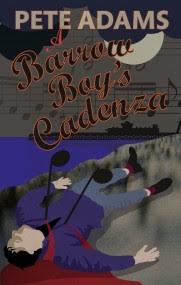
Eva Jordan reviews… A Barrow Boy’s Cadenza by Pete Adams

unnamed

How is it possible to read a book placed within the crime genre but spend most of your time laughing whilst reading it? Although filled with spooks, villains and a larger than life main protagonist, this clever crime story never failed to show the humorous side of life – even amongst the tragedy and loss one might expect from such a tale. Throw in some brutally honest political satire and I can safely say A Barrow Boy’s Cadenza is three genres rolled into one. I can also safely say I have never read a book quite like it and the author should congratulate himself on his clever writing style and apparent ease and ability to mingle and cross genres. 

Although this is book three of the Kind Hearts and Martinet series I have not, as yet, read the other two, and although I hope to do so in the near future, this book works perfectly well as a stand-alone. The principle setting is Portsmouth and having visited there myself a couple of times, the author does a great job of describing this historic port and Naval dockyard as well as some of its popular watering holes.

As with all great stories the main protagonist, the aging DCI Jack Austin (Jane to his friends), is wonderfully flawed but delightfully funny at the same time. Jack often talks to himself – out loud. He also has the unusual propensity to dish out rather amusing nicknames for all and sundry including Mandy, his long-suffering partner, often referred to as Mandy Pumps and Mandy Lifeboats but rather affectionately by her real name Amanda, during their more intimate moments. There is also Hissing Sid the desk sergeant, Jo Jums who is, in fact, Detective Inspector Josephine Wild and Colonel Horrocks nicknamed The General, just to name a few of the colourful but well-drawn supporting characters. 

The storyline has great pace and although this novel sits perfectly well within the crime genre, the plot is delivered with warmth and affection and a generous dose of farcical humour as well as some very poignant political commentary. Highly recommended to fans of comedy and crime alike.

Eva Jordan in conversation with… Margaret Kirk

Tales From Elsewhere - Margaret Kirk

My second guest author post today is by the very intriguing Margaret Morton Kirk, a writer living and working in her home town of Inverness. She has written a number of short stories, one of which, ‘Still Life’, was runner-up in the ‘Bloody Scotland’ short story competition in 2015.  It was later adapted for radio and broadcast on Radio 4 as part of its ‘Scottish Shorts’ series.

‘The Seal Singers’, a semi-mythic tale set in Orkney, won third prize in the 2016 Mslexia short story competition.  And ‘Coming Home’, a chilling insight into one family’s fragmented past, was published in the Tales from Elsewhere anthology.

Her debut novel, ‘Shadow Man’ is set in Inverness and is the first in a planned series featuring ex-Met DI Lukas Mahler. It is due to be published by Orion in July 2017.

Here, Margaret gives us some very helpful advice about writing the dreaded synopsis for a book…something I definitely struggled with!

Synopsis is a four-letter word…

Well, not literally…even my maths isn’t that bad. But whatever kind of writer you are, it’s a safe bet that writing a synopsis is your least favourite part of getting ready to submit your work. When I first thought about entering the Good Housekeeping novel competition, I wasn’t too worried about sending off the first couple of chapters—I’d worked hard on them and thought they were probably pretty much there. The synopsis, though…I spent a ridiculous amount of time drafting and re-drafting, and even once I’d sent it off, I couldn’t help thinking it could have been so much better.  But should crafting a synopsis really be such hard work?

On the face of it, synopsis-writing doesn’t seem that daunting. Most agents tend to prefer brevity (with good reason, given the number of submissions they receive each week) so in theory, all you need to do is write a concise but compelling summary of your book, in 500-700 words.  How hard can it be?  After all, you’ve already written 90,000 or so…

And that’s part of the problem, of course.  You’ve probably toiled over your novel for several months, maybe years.  You’ve re-drafted, re-examined every word choice, and it’s now as good as you can make it. You’re feeling endlessly chuffed for even finishing the wretched thing, for heaven’s sake…and now you need to compress the essence of those 90,000 words into a page or less (and no cheating with the margins or tiny fonts, in case you’re tempted). 

It’s as though your imagination’s being forced to hold a closing-down sale.  Everything must go, all the plot intricacies, the character nuances you’ve worked so hard on, and what you’re left with looks like…well, not very much. Certainly, nothing that would tempt you to ask to see more, so how can it possibly work any magic on an agent?

Well, there are two things to bear in mind. Firstly, I’ve attended writing events across the UK, and the consensus amongst the agents I’ve spoken to is that they won’t usually turn to the synopsis first. They’ll have a look at your writing and your cover letter, to decide a) if you can string two words together and b) if you sound like someone they could possibly work with. If they’ve done this and are getting good vibes so far, then they’ll turn to your synopsis.  They’ll do this to make sure that the clever premise and vivid writing of your first chapter don’t lead to a surprise intervention from little green men in chapter 28.  

Secondly—and I wish I’d known this earlier—you don’t need to tell them everything in the synopsis. The main plot thread, of course, and the events leading to the denouement, and the ending, absolutely…but you don’t need to detail every twist and turn along the way. If you do, unless your novel is linear and simple in structure, you risk getting bogged down in unnecessary and confusing detail. You need to give the essence of your story, not chapter and verse.

Sound easy?  Didn’t think so. But fear not, there is help out there: I’ve found the wise and sensible Emma Darwin’s blog a source of invaluable help on all matters technical.  And Write a Great Synopsis by Nicola Morgan is a handy little eBook you won’t want to be without. 

Follow their guidelines, and writing your synopsis needn’t be the carpet-chewing trauma that mine became…best of luck!

Margaret Kirk

Margaret Kirk on Social Media:
Website
Twitter 

Eva Jordan in conversation with… M.A. Comley

I am chuffed to bits to have the wonderful Mel Comley as guest author on my blog today. Author of the Justice Series and the Intention series, Mel is one of the few indie authors listed as a New York Times and USA Today bestselling author. Here, Mel gives us a fascinating insight into how she started her writing career.

*****

Thank you for inviting me, Eva, it’s been a long time since someone has asked me to write a blog post for them. 🙂

Now, what to choose as a subject, I know, how about writing!

To me, writing and entertaining my fans and the general reading public is like a drug. I’m addicted to writing. I have over thirty titles to my name now, most of which are fast-paced thrillers, the rest are either romances or some erotic titles that I write under a pen name.

My love of writing started when I moved to France back in 2002. I began reading a Mills and Boon romance, the only book available in English at a French library at the time, about halfway through the book I threw it down in disgust and turned to my Mother and said, “I could do better than this!” That day, I enrolled in a home study Creative Writing Course and wrote two romances, but I felt something was missing, it was a chore to write them to be honest. A friend of mine lent me a James Patterson novel and the speed of that book blew me away. It was then that I began writing Cruel Justice, that first book took me over 18 months to complete, however it was the second book in the Justice series, Impeding Justice, that I unleashed to the world first.

Back in 2010 the ebook market was still in its infancy, so I picked up some valuable fans right from the word go. Impeding Justice made it into the top 40 in the Amazon UK chart and in the top 100 in the USA. It was such a thrill to see the book doing so well that I quickly wrote Final Justice, when I say quickly, it still took over 6 months to write. When I released Final Justice my fans started writing to me asking to see more of Lorne and Pete’s relationship. I revisited Cruel Justice, tweaked it a little and then released that book. It was simply amazing to see Cruel Justice romp up the charts on both sides of the Atlantic and accomplish a top 20 place in the UK and settle in the top 30  in the USA, but what pleased me even more than the high rankings on my babies, was the wonderful emails I received from my fans, it simply flabbergasted me.

Now, I just can’t stop writing. In the past few months I’ve released The Caller, written by my co-author, Tara Lyons and myself, plus I have two more titles on pre-order, although Mortal Justice will have been released by the time this post appears. The other title, Devious Intention is due for release in Aug 2016, this is a psychological thriller, the third book in the Intention series about a PI duo, Ellie and Brian.

The past six years have been incredible for me, I’m one of the few Indie authors out there who is  listed as a New York Times and USA Today bestselling author but having those accolades under my belt hasn’t altered me at all. I still work over 100 hours a week, why? Because I love writing and entertaining people.

To anyone thinking that this writing lark is a way to make a quick buck – it ain’t. Only people who are committed to their craft and determined to succeed will make it in this world. It takes stamina and a lot of willpower to keep coming up with great plot ideas and believable and likeable characters who the reading public fall in love with.

Thank you again, Eva, I hope I haven’t bored people too much. 🙂

MelMel Comley

M.A. Comley on Social Media:
Website
Newsletter Sign Up
Facebook Page
Twitter