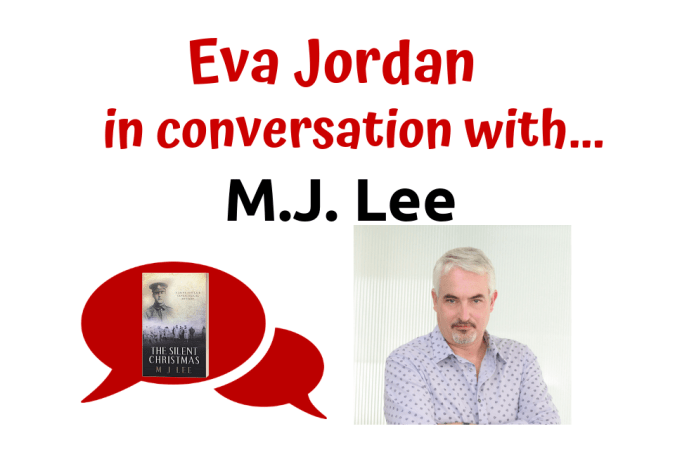
Eva Jordan in conversation with… M.J. Lee

Eva Jordan in conversation with M.J. Lee - Post Header

Last month, in honour of Remembrance Day, I wrote about my Great Great Uncle William who is commemorated on the Menin Gate. How apt then, when writing my column, I came across author Martin Lee’s recently published novella, The Silent Christmas, which finds Jayne Sinclair, a genealogical investigator, trying to unravel a mystery concerning her client’s great grandfather in the trenches on December 25, 1914. Read my review here to find out more but in the meantime, I’d thought we’d do an interview with the author himself.

Martin, can you please tell our readers a bit about yourself? How long have you been writing? Did you always want to be a writer?

I’ve been a writer for most of my adult life, but not a novel writer. I worked in advertising for over 25 years as a copywriter and creative director. Every day, I had to go into work and, in the blink of an eye, come up with creative solutions to business problems for clients. About four years ago, I was offered a new job and I had a chat with a headhunter who asked me what I really wanted to do with my future. Without a thought, I answered ‘write novels’. And now, here I am, with The Silent Christmas being my tenth book to be published, the fifth in the Jayne Sinclair series.

I really enjoyed The Silent Christmas, which falls into the historical fiction genre, however, I also understand that you’ve recently released a contemporary thriller called Where The Truth Lies? My question being, which do you prefer to write about, the past or the present?

I’m so glad you enjoyed The Silent Christmas, I really loved writing the book. The answer is both because the challenges are very different for an author. When writing about the past, you have to put yourself in the mind of the character, his or her beliefs, attitudes and thoughts at the time. Writing in the present is much more about the observation of people and events in one’s daily life. I think what links the two is the idea of character. What made people act the way they did, whether it is yesterday or 100 years ago. That’s what I love to write about.

What kind of research do you do, and how long do you spend researching before beginning a book?

I love research, it’s where you can escape the banal and ordinary and discover something new. As I write historical crime fiction, the mores, actions and beliefs of the time are present in all my work. Readers would soon point out (and have) anachronisms for me. Research allows me to stay true to the times whether its 1920s Shanghai, the Restoration period of Samuel Pepys, or the first year of the Great War.

I’m quite methodical, probably because I was at one time a researcher in history as well as my background in advertising. I start with some general books of the period, in this case, the lead-up and first year of World War One, so that I can understand what was happening on a macro level. Then I will read contemporary newspaper accounts of what happened. In most cases these are third hand, ie reporters writing about something told to them, but in the case of the Christmas Truce, some newspapers published letters from men at the front describing what had happened. At the same time, I will look at newsreel footage, programmes or films on the subject. Some of the participants actually described what happened on film. Next, I will read memoirs or first-hand accounts of what happened. There are three or four published accounts of the Christmas Truce the best being by Henry Williamson, Bruce Bairnsfather and Bertie Felstead. Finally, I will look at contemporary documents such as War Diaries and individual diaries kept at the National Archives or, in this case, at Cheshire Military Museum.

I’m generally researching two books ahead of my writing. So at the moment, I’m looking into the Emancipation of Slaves in 1834….

What is your writing Kryptonite?

Character. Why do people act like they do?

In The Silent Christmas, what made people, on both sides, stop killing each other for one day? What made people stop being enemies and become friends? And conversely, having met and chatted with their opposite numbers, how did they return to the trenches a day later and start killing again?

And finally, what one piece of advice would you offer any would-be writers out there?

Read. Read. Read.

But read smartly.

How is the writer telling his story? What are they trying to say? How are they saying it? What would you do differently? How have they built up character and themes? What genre are they writing in? How would you describe this book in one sentence?

And once you’ve decided to be a writer, never, never give up. There will come a point when you want to stop. Don’t. Push on through to the end, because nobody will ever read an unfinished book.

Writer Martin Lee

M J Lee on Social Media:
Website
Facebook
Twitter He’s nothing if not original with his handles (his words – not mine!).

Eva Jordan reviews… The Silent Christmas by M.J. Lee

Eva Jordan reviews The Silent Christmas - Post Header

Thanks to a cousin who has been researching our family tree, I recently discovered I had a Great-Great uncle who served in the trenches during WWl. He joined at the start of the war as a volunteer in 1914, and just one year later, aged twenty-one, he was dead, killed in action, his body never recovered but is commemorated on the Menin Wall in Ypres, Belgium. How apt then, I should stumble upon Martin Lee’s recently released novella, The Silent Christmas, the fifth in the Jayne Sinclair Genealogical Mystery series, which can also be read as a stand-alone.

Set in both the present day and the WWI trenches, the story centres on the informal football match believed to have taken place between the English and German soldiers during a brief truce on Christmas Day 1914. The first chapter takes us straight to the trenches on December 21st in Belgium, capturing the conditions and possible mindset of some soldiers, ‘He lay on his back on the hard ground and dreamt of England; picnicking on the grass in front of the bandstand, straw hat tipped over his eyes to shield them from the sun… A shadow crossed his face and he felt a tap against his foot. ‘Time to get up, Tom, we’re moving forward… The men began packing up… As they did so, a solitary shell from a German whizz-bang whistled overhead, landing one hundred yards past the farm. None of the men moved or even ducked; each one carried on preparing to move forward as if nothing had happened.’ We then move forward to the present day and discover Jayne Sinclair, a genealogical investigator, asked, just days before Christmas, if she can help shed light on the mystery of several items, namely a label, a silver button and a lump of leather, found in a chest in the attic of her client. Ms Sinclair, who says, ‘Our role as genealogists is to use our research to bring these lost people, the vanished people of our family, back to life,’ agrees, and the mystery begins to unravel.

Written in the third person throughout, The Silent Christmas is a fictional tale exploring the actual events that took place during December 1914, later called the ‘Christmas Truce.’ A real “feel good” story handled with great care and respect, full of hope and love, that is both well written and researched. And, as 2018 marks the 100-year anniversary of Armistice it is also particularly poignant.

You can find The Silent Christmas on Amazon 

Writer Martin Lee

M J Lee on Social Media:
Website
Facebook
Twitter

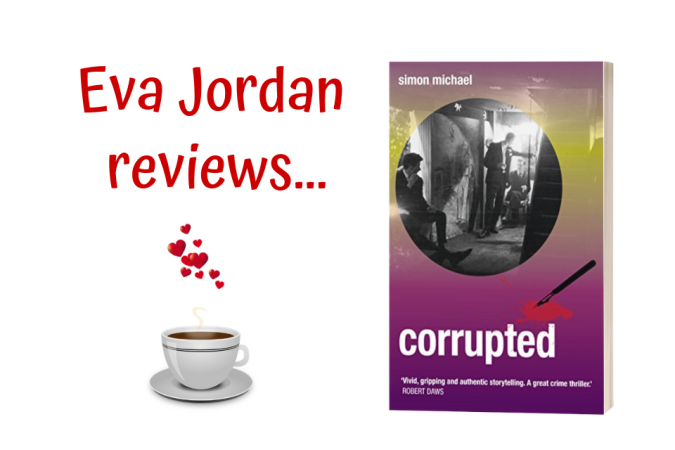
Eva Jordan reviews… Corrupted by Simon Michael


Eva Jordan reviews Corrupted - Post Header


Corrupted, the latest book by fellow Urbane published author Simon Michael, is the fourth in a series of noir gangster crime thrillers concerning criminal barrister Charles Holborne. However, although part of a series there is just enough back-story for it to read perfectly well as a standalone. Set in London’s swinging sixties, the author mixes historical fact with fiction, making Corruption a story that sees its fictional barrister, Charles Holborne QC, drawn into the real-life investigation of a sex ring scandal that involved the Kray twins and some very powerful but corrupt politicians. The author’s note reads, ‘This is not a true crime novel, but the historical facts upon which it is based did actually occur.’

Written in close third person, Charles, the flawed main protagonist, narrates throughout and the story itself unfolds during several crucial months of 1964, namely Friday 26th June–Monday 24th August. Charles, a Jewish East Ender doing well for himself, building his reputation as a brilliant murder trial lawyer, is living with his partner Sally. On the surface all looks well, however, Charles is clearly at odds with himself. ‘An East Ender, born and bred on the wrong side of town, the wrong side of the track and the wrong side of the law, Charles has muscled his way into the Establishment by becoming a war hero, barrister… His acquaintances include Oxbridge graduates with country seats, titles and racehorses; they also include boxers, burglars and con artists. He no longer quite fits in anywhere, and everywhere feels like the wrong place.’

Charles is asked to help a young lad called Teddy who has been arrested and accused of murder. Charles agrees to take the case on and in doing so takes the reader on a magical mystery tour of 1960s London including the music, fashion and haircuts of the time. The author also gives the reader a fascinating glimpse of Fleet Street during the sixties, sprinkled with sporadic but fascinating historical facts like the time Charles takes a run past Jack Straw’s Castle–the pub and reputed favourite haunt of Charles Dickens, Karl Marx and Bram Stoker. However, at the heart of this story is a dark, uncomfortable tale about power, corruption and sexual abuse. Pacey, but often sombre and heartbreaking, it also includes great dialogue and some extremely well-written courtroom drama. A thrilling page-turner and one I highly recommend.

Eva Jordan in conversation with… Betsy Reavley

Eva Jordan in conversation with Betsy Reavley

On my blog I’ve been lucky enough to host some great interviews with some amazing local authors, and just recently that extended to a wonderful and informative Q&A session with prolific book blogger, Linda Hill, which you can read here. However, this month I’m really honoured to bring you an interview with someone who is both a successful author and one half of a successful husband and wife team behind the publishers Bloodhound Books and Bombshell Books, Betsy Freeman Reavley. 

  1. Hi Betsy, can you tell everyone a bit about yourself? 

I began my career as a writer and started my first novel when I was twenty-two years old. After having my first daughter and then getting married, I finally got round to finishing it and I was thrilled when an indie publisher offered me a contract and went on to publish the book.

The birth of eBooks and Amazon changed how people could publish and gave me, and my husband, an opportunity to start our own business, which we did in 2014. Bloodhound Books was born and we’ve never looked back. 

  1. What is the most difficult/frustrating part of being a publisher? 

The publishing world has changed since the birth of eBooks. Many authors still think of publishing in traditional terms and some authors struggle with the idea that our focus is on eBook sales, despite the fact we also produce paperbacks.

  1. As we all know, life can be difficult at times. Do you have a quote (either your own or someone else’s) or a motto that you try and live by, not just during the tough times but the good ones too? 

I listen to music to encourage me to focus my mind. Anything from BB King to Eminem will help me concentrate on what I want to achieve and keep going. The lyrics are all important to me and I take strength from them. I also love poetry, which inspires me to never give up.

  1. Truthfully, which do you prefer, writing or publishing?

They are both fulfilling but require very different skill sets. I couldn’t say. The pressure from publishing can be stressful but keeps life interesting. Writing is a lonely pursuit but one that I love.

  1. Do you read your book reviews? How do you deal with bad or good ones? 

I used to read every review, taking each to heart, whether those words were good or bad. I am grateful to anyone who takes the time to leave a review, be it good or bad, but I’ve grown a thicker skin and now worry much less. What I do care about are sales figures. I am not a literary writer who does it for the art of writing. I am a career woman and I want to make a good living.

  1. And finally, what advice would you offer anyone thinking of becoming a writer or a publisher?

I don’t think you can advise someone how to become a writer. It’s either in you to do it or it isn’t. Writer’s write, it’s that simple. As for publishing, I never thought I’d end up being a publisher but I have discovered that I enjoy business and the opportunity to give talented writers a platform. The one thing I would always encourage people to remember is that publishing is based on opinions. Do I like this book? Can I sell it? What one publisher may think another may disagree with. Neither is wrong. It’s all just opinion. As long as you remember that, then you’ll keep your head screwed on properly.


The Go-Between and The George!

The Past is a foreign country;they do things differently there_ – L P Hartley

I live in a small Fenland town called Whittlesey which is six miles to the west of Peterborough, eleven miles to the east of March, bordered to the north by the River Nene and to the south by Whittlesey Dyke. For such a small town it is rich in history and was once connected to Peterborough and March by the Roman road, Fen Causeway, constructed in the first century AD, which is the approximate route of the modern A605 road used today. Whittlesey also appears in the Cartularium Saxonicum (973 A.D.) as Witlesig, in the Domesday Book as Witesie, and in the Inquisitio Eliensis (1086 A.D.) as Wittleseia.

whittlesey-marketsquare

Whittlesey in the 1940s.

Recently, while waiting to meet a couple of friends at one of the local pubs in Whittlesey, The George (which you can see to the left in the above photo), a grade II listed building (also rich in history) which dates from the late 18th century and whose landlords can be identified as far back as 1830, I happened to look up, and there on the wall opposite was a framed black and white photo (one of many adorning the walls) of a rather serious, rather dapper looking gentleman. Curious, I moved in for a closer look. Bespectacled and sporting a very bushy moustache, not unlike that worn by Tom Selleck during his Magnum PI days (showing my age now!), his chin resting on his hand in a somewhat contrived pose, the name above his head read, L.P. Hartley. Not to be confused with J.R. Hartley – a fictional character and said author in a popular TV advertisement promoting the Yellow Pages back in the early 1980’s that sees an elderly gentleman trawling second hand bookshops for a book called Fly Fishing – L.P. Hartley was, I discovered, actually a bona fide author of several famous works of fiction (one of which contains one of my favourite quotes – above) with a local connection.

L P Hartley

Leslie Poles Hartley (named after Leslie Stephen, who was, among other things, an author, critic, and historian, not to mention the father of Virginia Woolf and Vanessa Bell) was a British novelist and short story writer, born 20th December 1895 – in Whittlesey. The son of Bessie and Harry Bark Hartley, a solicitor, Leslie also had two sisters, Enid and Annie Norah. While he was young, the family moved to Fletton Tower, a small country estate near Peterborough. However, most of his schooling took place in Cliftonville, Thanet, and Clifton College, Bristol. He completed his education at Balliol College, Oxford, where he read modern history and also met and befriended fellow writer, Aldous Huxley (Brave New World). Some of his early works of fiction were published in the early 1920’s, however, his writing career, much to his disappointment, was slow to take off. It was only during later life that he began to experience serious success. His best-known novels are the Eustace and Hilda trilogy (1944-7) and The Go-Between (1953 – where the above quote comes from), which was made into a film in 1971 starring Julie Christie (a photo of which also sits alongside Hartley in the same frame) and Alan Bates. Offering a critical review of society at the end of the Victorian era, the New York Times described the novel as “a triumph of literary architecture.” The Go-Between was joint winner of the Heinemann Award and Hartley was awarded the CBE in 1956. Hartley died in London on 13 December 1972 at the age of 76, however, I think I can safely say L.P. Hartley was a local boy done good!

Eva Jordan reviews… Before The Fall by Juliet West

EVa Jordan reviews Before The Fall - Post Header

A great war.
A powerful love.
An impossible choice.

A tale of forbidden love, Before The Fall is beautiful, poignant and heartbreakingly sad. Set in London’s East End during the First World War, this is a fictional tale based on true events.

Hannah Loxwood is the struggling young mother of two children, namely 4-year-old Alice and 2-year-old Teddy. Her husband, George, one of many young men who has voluntarily enlisted to fight in the Great War, is across the channel, fighting. To help make ends meet, Hannah and her children move into the home of her older sister, Jen, and brother in law, Alec, and to help pay her way Hannah takes a job offer in a local café. There, she meets Mr Blake, Daniel, a welder. “This man, he’s not like your average docker. He’s well built all right, strong like you have to be, but there’s something unusual about him. A word comes to my mind – elegant – and I tell myself not to be so daft. It isn’t a word I’ve thought of before, let alone said.” Hannah quickly realises she is drawn to the quietly intriguing Daniel in a way she neither expected nor anticipated. The feeling, as it turns out, is mutual. “All the single girls in London and he has to fall for a soldiers wife … beautiful, odd, vulnerable.” Nonetheless, Hannah is a married woman; social norms must be observed at all times. Hence Hannah and Daniel must do their level best to suppress any thoughts or feelings that go beyond friendship. However, as the war rages on, Hannah finds herself wondering if her husband will ever return home again – and if indeed she actually wants him to.

Well researched, full of fascinating historical details, including police statements, newspaper reports and witness statements, Before The Fall is a brilliantly crafted, superbly written novel. The characters are well rounded and believable, especially Hannah, written in the first person – whom I became highly invested in – and Daniel, written in the third person. The author’s prose is wonderfully captivating and highly evocative – I could see the smog, smell the river, feel the hunger, and sense the desperation. However, although set amongst the fear and uncertainty of war-torn London, this is not a war story but rather a mesmerising, realistic, and haunting tale of love. It is also a story about the plight of women, their sad indictment and the difficulties they faced if caught challenging a ruthless wartime society. A sensitive, powerful, must-read.


Book Bloggers – The Unsung Heroes Of The Book World

10011593_1786471088245862_5398185122946055833_o

Once a month I write a column for a local lifestyle magazine called The Fens. As well as offering writing advice I’ve also had the pleasure of doing some great interviews with some amazing authors. However, this month I thought I’d chat with one of the many brilliant unsung heroes of the book world, namely Linda Hill – book blogger extraordinaire. Among other things, Linda – a prolific reader – writes book reviews, takes part in blog tours and regularly hosts author guest posts on her award-winning Book Blog, Linda’s Book Bag. And like many book bloggers, this is all done in her spare time for nothing more than the sheer love of books.

  1. Hi Linda, can you tell our readers a bit about yourself?

Hi Eva. I’m a passionate and eclectic reader (and a bit of a closet writer) who used to be an English teacher, inspector and educational consultant. I’m self-retired and love books and travel.

  1. Have you always enjoyed reading books and when did you first become a book blogger?

I was a late reader as my sight is so poor that I didn’t realise those squiggles on a page had meaning! Once I got glasses at 7 there was no stopping me and I still have my childhood Paddington books.

I began blogging three years ago when I decided life was too short to keep working and I wanted to share my love of books. Since then my blog has grown and I might even say has got out of hand!

  1. And finally, what advice would you offer anyone thinking of becoming a book blogger?

Learn to say ‘No’. There are only 24 hours in a day. It’s so tempting to accept every book you are offered for review and once you get known, the books keep arriving even if you’re not expecting them – I currently have over 900 physical books that have just turned up and I can’t get into my study.

Bloggers need to be very active on social media like Twitter and Facebook so that lots of readers see their blog posts.

I’d also say that authors never set out to write a bad book so be constructive and kind in reviews. A book that may not appeal to one person might be perfect for another reader.

I’d urge ALL readers to review on sites like Amazon and Goodreads, as well as a blog, as this is the only way many authors can get their books noticed.

And blog often!

It’s Just My Point Of View – POV!


It'sJust My Point Of View2

A couple of months ago I wrote about the different types of writer there are (see here), namely Plotters, Pansters or, as in my case, Plansters! This month I thought we’d take a look at one of the more important literary devices of a novel, often referred to as Point of View – or POV.

For now, I’ll keep it simple and look at the three most popular POV’s. 

First Person Narrator – is from a single perspective, a personal one – where the narrator uses words like “I” and “me” and “my” – and where the world the writer creates is seen through the eyes of a single character. 

Pros – first person allows you and the reader direct access to what your character is thinking and feeling. This means your readers are instantly connected with your narrator, creating more empathy and emotional investment in your overall piece.

Cons – there are limits as to what your narrator can and cannot relay to your reader. Everything is from a particular person’s line of sight so there will be details that they and therefore your reader, won’t know.

Second Person Narrator – uses the pronoun “you” and puts the reader into the story, and if done right can plunge the reader into the narrative completely. 

Pros – you can tell the reader what to feel and how to react, and, as they are part of the story, by default there is already a strong sense of empathy.

Cons – writing in the second person has to be done carefully to avoid poor writing. Also, by telling the reader what they are thinking and feeling, you run the risk of alienating them.

Third Person Narrator – a popular POV, is a narrator who tells the story from outside the narrative itself and uses phrases such as “he said” and “she said” and gives the author the option of an omniscient narrator (an all-knowing narrator) – who knows every character, every event and every detail.

Pros – generally, writers have more freedom and fewer limitations when it comes to third person narration.

Cons – what a writer gains in narrative freedom they lose in intimacy. This POV doesn’t give characters a direct voice to the reader. The narrator is not speaking subjectively to the reader so it can make it harder for them to empathise and connect with characters.


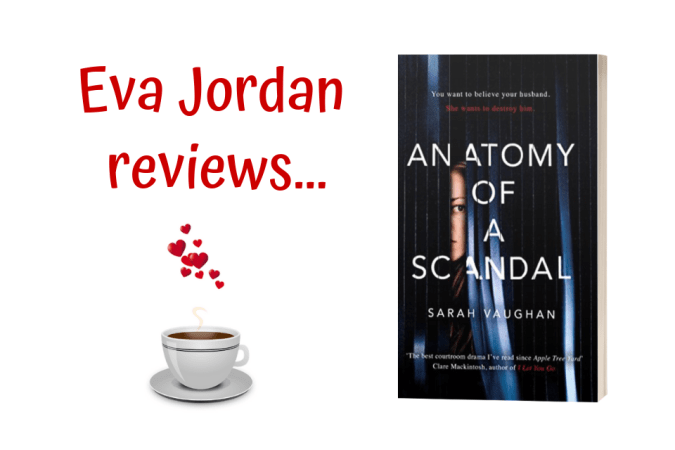
Eva Jordan reviews… Anatomy of a Scandal by Sarah Vaughan

Eva Jordan reviews Anatomy of a Scandal - Post Header

They say timing is everything and to my mind, this is a story that couldn’t be more socially and politically relevant. With global movements like #MeToo and #TimesUp, Anatomy of a Scandal delves into the murky waters of sexual harassment, political corruption and abuse of power, the underlying suggestion that the perpetrators of such deeds are often orchestrated by those who have obtained their position in life through privilege and opportunity.

The story centres around three key characters, namely Kate, a highly ambitious barrister, James, an MP and close friend of the Prime Minister, and Sophie, his loyal wife. Kate, working class, single and child-free, has worked hard to forge a successful career for herself. With a few close friends and barely any social life she is a somewhat serious character. She also has a strong belief in right and wrong, in justice, which in part powers her ambition to succeed. However, as the story evolves, you can’t help but wonder what other forces fuel her drive.

James, Oxford-educated, is both charming and attractive. Unlike Kate, James, thanks in part to his privileged upbringing, has a strong sense of entitlement and, despite his charming façade, harbours a sanctimonious disdain for anyone he believes is beneath him, including most women. Sophie, James’s wife, recalls a conversation with her husband, “‘The trouble with women,’ James once told her, making the sort of sweeping generalisation he would never make in front of female colleagues but did at home, ‘is that they lack the courage of their convictions. Mrs Thatcher aside, they don’t have our self-belief.’”

Sophie, with “a look that belonged to a certain class” is both snobbish and elitist, “James will be fine (she says when her husband is accused of a criminal offence) because he is the right type … and he has the prime minister’s patronage.” She is not a particularly likeable character but she does redeem herself towards the end of the story.

Part courtroom drama, part psychological thriller Anatomy of a Sandal is set during the present day with flashbacks to the past. Gripping and pacy it is extremely well written with believable, well-rounded characters. A timely thought-provoking study of class, privilege and toxic masculinity, eerily echoing recent and current debate. A brilliant read and one I highly recommend. A big fat five stars from me!

Eva Jordan in conversation with… Ross Greenwood

Ross Greenwood

Each month I write a column for local (to me) lifestyle magazine The Fens and after reading and reviewing the brilliant Fifty Years of Fear (book 1 of his Dark Lives Series) by Ross Greenwood, I thought it a good idea to chat to the author himself.
Pictured from right to left: Ross Greenwood, author Jane E James, and myself

From right to left: authors Ross Greenwood, Jane E James and me!

  1. Hi Ross, can you please tell us all a little bit about yourself? How long have you been writing and did you always want to be a writer?

I’m 44 and was born in Peterborough. I travelled all around the world, living in Australia and Gibraltar of all places. Then I met my soon to be wife walking a dog about 50 metres from my back door next to the River Nene! I had an urge to write a book about 10 years ago, but life (kids actually) got in the way. The drive to finish it became irresistible, and I wrote Lazy Blood between 4 and 6 am after being woken up by son’s request for milk.

  1. I really enjoyed reading Fifty Years Of Fear (read my review here) and from what I can gather your first three novels are set in or around Peterborough, can you tell us why? Is it important to you to ‘write what you know’?

Fifty Years, Lazy Blood and The Boy Inside are all set in Peterborough. I wanted to write about my home town as there are few books set here. The ones that are, often portray a stark place that I don’t think exists. Characters from each book may pop up in the others, but they can all be read standalone. I worked in the prison for four years and used my experiences there to portray modern lives told with humour. I find writing flows when you pull the information from your own memory.

  1. And finally, for any would-be writers out there, what one piece of advice would you offer them?

You’ll find lots of people have advice about writing, but everyone’s journey is unique. The only advice that is guaranteed to be correct is to pick up your pen and begin. Then you are a writer, whatever anyone says. It’s unlikely you’ll make much money from it, but it’s a wonderful thing to do. Holding your own first book is an experience that’s within your reach, if only you pick up that pen and write.

Thank you for being a great guest, Ross. If you want to connect with Ross on social media you can find him on:
Facebook
Twitter

ross

Ross has also recently released his fourth novel, Abel’s Revenge, which is getting some rave reviews. Check it out here and here.

516IbC+QdJL